A Full Day in Mostar: The Complete Itinerary
What's the best way to spend one full day in Mostar?
Start early at the Stari Most and Kujundžiluk before the coach groups arrive, use the hottest midday hours for an Ottoman house museum or a shaded meal, then walk the Bulevar and a memorial site in the afternoon, and save Hum hill for the last two hours before sunset when the light is soft and the heat has broken.
Why a full day changes what you see in Mostar
Most visitors arrive on a coach from Dubrovnik or Split, get two or three hours around the Stari Most, and leave before the town shows its other sides. A full day rearranges the same town around the two things that actually punish a rushed visit: the coach-tour crowds that peak mid-morning, and the heat that peaks mid-afternoon.
If you only have a few hours rather than a full day, the condensed version of this walk is covered in a half-day itinerary for Mostar — this page assumes you’re staying the whole day inside the town itself, with no excursion outside it. For a day trip to Kravice, Blagaj, or Medjugorje instead, see the guide to day trips from Mostar.
The logic of this itinerary is simple: front-load the bridge and the bazaar before the buses arrive, use the punishing midday hours for something shaded, and save the one outdoor climb of the day — Hum hill — for the last two hours before sunset, when the light is best and the heat has broken. Doing it the other way around, climbing Hum at 1pm in July, is the single most common way to ruin an otherwise well-planned day here.
Morning: the Stari Most and Kujundžiluk before the coaches arrive
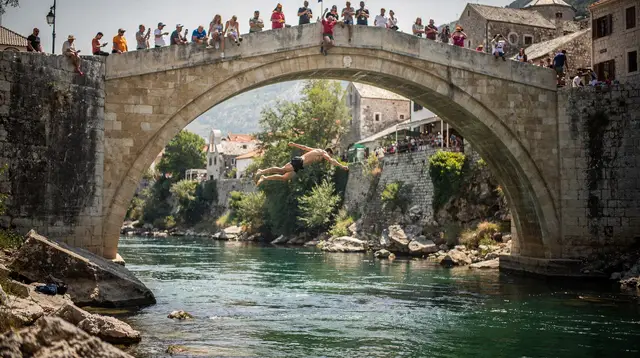
Start at the Stari Most itself, ideally by 8am. The bridge was built in 1566 on the order of Sultan Suleiman the Magnificent, destroyed by shelling on 9 November 1993, rebuilt using the original Ottoman techniques, and reopened on 23 July 2004; the old town around it became a UNESCO World Heritage site in 2005. Early morning is when the stone is at its coolest underfoot and the crowds are thinnest — by 10 or 11am, tour groups fill the same narrow span shoulder to shoulder.
This is also the best window to watch the local divers. The tradition goes back to 1664 and today runs through the Mostari club, founded in 1994, which trains young divers from childhood and stages competitions from the bridge’s parapet. A tourist can pay to jump too — a practical walkthrough of cost, technique, and what the club membership includes is covered in a dedicated guide to jumping from the Stari Most, while watching the divers costs nothing and takes only a few minutes if jumping isn’t your plan for the day. Either way, morning is when divers are most likely to be active, before the day heats up.
From the bridge, drop into Kujundžiluk, the old copper bazaar that runs along the eastern bank. Coppersmiths have worked this street for generations, hammering bridge motifs, pens made from spent shell casings, and coffee sets into thin sheets of metal; a closer look at the craft itself is in the guide to copper work in Kujundžiluk. Morning here means shopkeepers setting up rather than a solid wall of tourists, and it’s a good half hour to an hour of browsing before the lanes fill in.
Follow the morning with the Koski Mehmed-Pasa mosque, a short walk from the bazaar. The minaret climb is about 90 narrow steps, and the reward is one of the better elevated views of the bridge and the old town roofs — a useful reference point before deciding, later in the day, whether Hum hill or one of the other elevated spots suits you best; a roundup of the town’s best viewpoints compares them directly.
Entry to the mosque and the minaret climb are usually charged separately, on the order of a handful of convertible marks each rather than a fixed combined price — expect to pay in KM even if euros are accepted, since change comes back in local currency (more on that in the money section below).
By late morning, aim to have covered the bridge, the bazaar, and the mosque. This is roughly three hours of walking and stopping, and it’s the busiest stretch of the old town’s day — the earlier you move through it, the more of it you’ll have mostly to yourself.
Midday: use the heat, don’t fight it
Mostar is the hottest city in Bosnia and Herzegovina, with July and August averages around 27-28°C and spikes measured well above 40°C during heat waves. The old town has very little shade, and by noon the stone underfoot and the narrow lanes trap heat rather than dissipating it. The mistake to avoid here is treating midday as just another slot for outdoor sightseeing — it’s the one part of the day built for being indoors or under cover.
This is the right window for one of Mostar’s Ottoman house museums. The Bišćević house and the Muslibegović house both preserve 17th- and 18th-century domestic architecture around shaded courtyards, and both charge only a few euros or the KM equivalent at the door — a guide to both houses, what each one shows, and how they differ is linked above. Their courtyards, often with a fountain and heavy stone walls, are noticeably cooler than the street outside, which makes late morning to early afternoon the natural slot for this stop rather than the golden-hour walk later in the day.
Pair the house visit with lunch. Try ćevapi — small grilled sausages served in flatbread — or burek, the meat-filled pastry sold in most old-town bakeries, ideally at a table under cover rather than in direct sun. A neighborhood-by-neighborhood rundown of where to eat is in the guide to eating in Mostar. If you’d rather turn lunch into something more structured, an olive oil tasting paired with local bites works as a sit-down, shaded midday stop:
a guided olive oil and local food tasting gives the midday slot a fixed activity rather than just downtime, and it’s timed to sit through the hottest hours rather than compete with them.
More broadly, the summer heat here deserves its own planning, not just a lunch workaround — a full guide to Mostar’s summer heat covers hydration, timing, and what to expect hour by hour in July and August specifically.
Early afternoon: the Bulevar and a site the war actually shaped
Once the worst of the midday sun has passed — figure 2:30 or 3pm as a rough turning point — move to the Bulevar, the avenue that ran through Mostar as the real front line of the 1992-1995 war, not the river as visitors sometimes assume. Walking even a short stretch of it, past buildings still pocked with shellfire and bullet damage, gives a more accurate sense of how the town was actually divided than the reconstructed bridge does on its own.
A closer look at what’s visible today, and how to read it responsibly, is in the guide to the war’s visible traces in Mostar, and the wider context of the conflict itself is covered in an overview of the 1992-1995 war in Mostar.
From there, the Partisan Memorial Cemetery is a short taxi ride or a longer walk uphill. Designed by architect Bogdan Bogdanović and opened in 1965, it was damaged during the 1990s conflict and left neglected for over a decade before restoration work began in 2005 with Dutch and Norwegian funding alongside local co-financing. It’s maintained and staffed today, not a ruin — a terraced, quiet counterpoint to the crowded old town, and worth 30-45 minutes if war-era and Yugoslav-era history interests you.
If it doesn’t fit your afternoon, the Museum of Herzegovina in the old town covers similar ground indoors and pairs more easily with the rest of a walking day; either way, a broader look at war-history exhibitions in Mostar helps decide which one earns your remaining time.
Late afternoon and evening: Hum hill for the light, not the heat
This is the piece of the day worth protecting: Hum hill, the highest point overlooking Mostar, is best climbed in the last two hours before sunset, not at midday. The path and the road both gain real elevation with little shade along the way, and doing this climb at 1pm in a Mostar summer means combining direct sun with sustained physical effort — the exact combination the rest of this itinerary has been arranged to avoid.
Head up starting around 5 to 6pm depending on the season, and you’ll reach the cross at the top as the light turns gold over the Neretva valley, the old town roofs, and the hills beyond — one of the more complete photography guides to this specific window is in the guide to sunrise and sunset photography in Mostar.
If cycling suits you better than walking or a taxi for the approach to Hum, renting a bike is a practical way to cover the distance without the midday sun working against you in the earlier part of the climb:
renting a bike in Mostar is worth considering specifically for this leg of the day, since the road up has stretches too gradual to justify a taxi but long enough to make walking slow in the heat.
For a different kind of late-afternoon thrill closer to the old town itself, rather than a hilltop climb, a glass bridge zip line experience near the Stari Most gives an adrenaline alternative that doesn’t demand the same uphill effort:
a glass bridge zip line experience can slot into the late afternoon instead of the Hum climb on a day when the heat hasn’t let up, or as an add-on before the sunset walk if you have the stamina for both.
End the day back in the old town with dinner, and consider closing with a tasting rather than another walk — a full day of heat and stone streets earns a sit-down finish:
a guided rakija tasting is a fitting way to close out a long day on your feet, pairing Herzegovina’s fruit brandy with a calmer, seated pace after a day that’s mostly been spent walking and climbing.
The day at a glance
| Time | Stop | Why this slot |
|---|---|---|
| 8:00-9:00 | Stari Most, watch the divers | Before coach groups arrive; coolest hour of the day |
| 9:00-10:30 | Kujundžiluk bazaar | Shops setting up, lanes still walkable |
| 10:30-11:30 | Koski Mehmed-Pasa mosque and minaret | Elevated view before midday haze and crowds build |
| 11:30-14:00 | Ottoman house museum + lunch | Shaded courtyards, hottest hours of the day |
| 14:30-16:00 | Bulevar and a memorial site or museum | Heat easing; indoor option if it isn’t |
| 17:00-19:00 | Hum hill for sunset | Cooler air, golden light, no midday climb |
| 19:00 onward | Dinner, tasting to close | Seated, low-effort end to a long day |
What this itinerary assumes, and what it doesn’t cover
This is a town-only day: it doesn’t include Kravice, Blagaj, Počitelj, or Medjugorje, all of which need a car, a tour, or a full separate day to do properly — see the guide to day trips from Mostar for those.
If you’re weighing whether one town-only day is actually enough for your trip, or whether you should add a second day for the surrounding sights, the guide on how many days to spend in Mostar and the comparison between a day trip and a longer stay both address that directly. For a version stretched over two or three days instead of compressed into one, see a two-day Mostar itinerary or a three-day Mostar itinerary.
Everything in this itinerary is reachable on foot or by a short local bus ride, and getting between stops without a rental car is covered in the guide to getting around Mostar on foot and by local bus; a fuller no-car version of a Mostar stay is at Mostar without a car.
Bring cash: the local currency is the convertible mark (KM, BAM), fixed permanently at 1 EUR = 1.95583 KM under a currency board arrangement — not a floating rate — and while euros are often accepted at tourist-facing counters, change comes back in KM. A fuller rundown of paying and carrying cash here is in the guide to money and payment in convertible marks.
One last note on pace: this itinerary works because it respects Mostar’s own rhythm rather than fighting it — busy mornings, brutal midday heat, and a beautiful last light. Try to compress it further and something gets rushed, usually the Hum hill sunset, which is the one part of the day that doesn’t reward hurrying.
City sightseeing tours on GetYourGuide
Verified deep-linked GetYourGuide tours. Book through these links and we earn a small commission at no cost to you.
GetYourGuide does not provide a product photo for this activity — the image shows the meeting point, photographed by us.