War Photography Exhibitions in Mostar
Where can I see war photography exhibitions in Mostar?
A handful of small, privately run galleries near the Stari Most and Kujundziluk show black-and-white photography from the 1992-1995 siege. They are not a single official museum — expect one or two rooms, a modest entrance donation, and opening hours that shift by season and by who is at the door that day.
Walk a few minutes back from the crowds photographing the Stari Most and you will pass, easy to miss, a doorway with a handful of framed black-and-white prints and a small sign in two or three languages. Step inside and you are usually in someone’s personal archive: a local photographer’s negatives from 1992 to 1995, printed and hung in a room the size of a large living room, with no ticket desk, no audio guide, and no promise that the same photographs will still be there next year.
This is the quieter, less organized layer of war memory in Mostar — smaller and more personal than a formal museum, and easy to overlook if you are moving quickly between the bridge, the bazaar, and the mosque. This guide is about that specific layer: what these exhibitions actually are, what you will see inside them, and how to visit without mistaking a one-room private gallery for an official, permanent institution.
A different kind of war memory in Mostar
Mostar’s most visited war-related sites tend to be outdoor and physical — the rebuilt Stari Most itself, the Bulevar that marked the front line rather than the river, and the restored Partisan Cemetery on the hillside above downtown. Photography exhibitions sit apart from all of that. They are indoor, curated, and built around a single photographer’s or collector’s body of work rather than around a monument or a battlefield.
Because they are privately run, there is no single body coordinating them, no shared opening-hours calendar, and no guarantee that a gallery open last season is still open this one. Some operate seasonally, opening only in the warmer months when footfall through the old town is high; others are tied to a shop, a café, or a family home and keep hours that depend on whoever happens to be around. Treat any specific address, name, or set of hours you find online — including anything written here — as a starting point to confirm once you are in Mostar, not as a fixed schedule.
This guide does not retell the history of the 1992-1995 war itself — for that, this site’s overview at comprehending the war and its arc through Mostar is the better starting point. It also does not cover the city’s broader heritage museums, which are handled separately in the guide to the Museum of Herzegovina. What follows is narrower and more practical: how to find and read these small photography spaces on their own terms.
What these exhibitions actually look like
Expect a single room, sometimes two, with framed prints on the walls and minimal explanatory text — often a line or two of captioning per photograph rather than long historical panels. Many were taken by residents of Mostar who lived through the siege and later chose to print and show their own negatives, which gives the images an unmediated, first-person quality that a large state museum rarely offers.
Common subjects include:
- The destroyed Stari Most in the days and months after 9 November 1993, before reconstruction began
- Shelling damage to buildings that are now repaired, rebuilt, or still standing half-ruined
- Daily life continuing under siege conditions — queuing for water, moving through streets under sniper risk, improvised repairs
- Portraits of residents, sometimes named, sometimes anonymous
- A smaller number of images from the Bulevar itself, the avenue that actually divided the city rather than the river most visitors assume was the boundary
Framing is usually simple: black-and-white prints, sometimes contact-sheet-style groupings, occasionally paired with a short handwritten note from the photographer. Do not expect the production values of a national museum — the modesty of the presentation is part of what makes the format feel personal rather than institutional.
Not a museum — and why that matters
This is the point worth being deliberate about: these are not branches of a single official war museum, and treating them as one leads to mismatched expectations. There is no unified ticketing, no fixed collection that stays in place for years, and no guaranteed English-language signage throughout. A gallery might be run by the photographer themselves, by a family member, or by a small local association, and it can close for a season, move location, or change what it shows with little notice.
If you want the more institutional version of Mostar’s history — object collections, longer historical explanations, a building purpose-built for the role — that is the Museum of Herzegovina, which spans a much wider period than the 1990s war alone. If you want a sense of what is still physically visible in the streetscape without stepping indoors at all, the separate guide to the war’s visible traces around the city covers that ground.
What the small galleries offer that neither of those does is proximity: photographs taken by people who were there, shown in spaces that have not been smoothed into a standard museum format. That is the trade-off — less context, less certainty about opening hours, more direct contact with a single photographer’s record of the siege.
Where you’ll find them, and when
Most of these spaces cluster within a short walk of the old town core, close to Kujundziluk and the approaches to the Stari Most — the same few streets most visitors already pass through on the way to the bridge and the mosque. A smaller number sit slightly further out, mixed in with residential streets rather than the tourist-facing lanes.
| What to expect | Detail |
|---|---|
| Format | One or two small rooms, framed prints, minimal panels |
| Typical visit length | 20 to 40 minutes |
| Entrance | Small donation or a few convertible marks, cash, paid at the door |
| Language | Bosnian and English captions common; French, German, Italian less consistent |
| Hours | Vary by season and by venue; some open only in high season |
| Photography inside | Ask at the door; policy is rarely posted |
Because none of this is centrally coordinated, the most reliable approach on the ground is simple: walk the lanes just off Kujundziluk in the late morning or afternoon, when small businesses in the old town are most likely to be open, and look for a doorway with prints visible from the street. Old town shopkeepers and guesthouse hosts in Mostar are generally aware of which spaces are currently operating, since the list shifts from year to year — asking locally on the day tends to work better than relying on a list fixed months in advance.
If you are staying more than a night, building this into a slower first morning works better than trying to fit it between other stops — the guide to how many days to allow in Mostar and the two-day itinerary both leave room for this kind of unplanned old-town wandering rather than a fixed list of sights.
What the photographs show — and what they leave out
The strongest material in these exhibitions tends to be the ordinary detail: a shopfront with a shell hole patched over, a queue for water on a street that is now lined with cafés, a portrait of a resident who may still live in the city. These images sit at a different register from the general historical account of the war — they show a specific street, a specific face, a specific week, rather than an explanation of how the front formed or why it ran along the Bulevar rather than the river.
That specificity is also a limitation. A single photographer’s archive reflects what they could reach with a camera during the siege, not a full account of the war across Herzegovina or Bosnia. For the wider picture — how the conflict started, why the city ended up divided along an avenue rather than by the Neretva, and how that division persists in the city’s administration today — the dedicated guide to understanding the 1992-1995 war in Mostar is the more complete reference, and the war memory itinerary links the physical sites together if you want to spend a half-day on this theme specifically.
Two pieces this site publishes elsewhere are worth reading alongside a visit: an essay on what the rebuilt bridge actually signals about reconciliation, and a shorter piece on a monument most visitors walk straight past on the way to more photogenic sights. Both sit closer to reflection than to a straight sightseeing brief, which mirrors the tone of the galleries themselves.
A quiet counterpoint to the rest of old Mostar
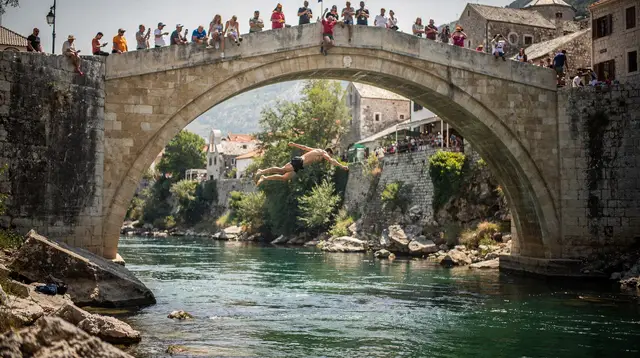
It is worth naming plainly what a visit like this asks of you: fifteen minutes earlier you may have been watching a diver leap from the Stari Most to applause, and fifteen minutes later you might be standing in front of a photograph of the same bridge in ruins. Mostar holds both registers at once, and neither cancels the other out. The city is not a theme park built around the war, and it is not a memorial site where lighter activities are out of place — it is a functioning city that happens to carry this history visibly, a few streets apart from where people now eat, drink, and swim.
If you want to sit with the subject for longer, the guide on tourism of memory across Herzegovina sets out how to pace a day that includes this kind of material without it dominating the whole trip, and the guided old-town walking tour is one practical way to have a local guide point out which buildings still carry visible war damage versus what has been fully rebuilt.
For a lighter contrast on the same afternoon, old Mostar also rewards simple wandering with a camera of your own — the separate guides on photographing Mostar at sunrise and sunset and on practical tips for photographing the old town cover that more upbeat side of the same streets. And if you would rather move around the old town and up toward Hum hill under your own power between stops, renting a bike is a simple, flexible way to string a few of these locations together: renting a bike in Mostar covers the old town and the approach roads at your own pace.
Practical notes before you go
A few things worth knowing before you set out to look for these exhibitions:
- Bring small cash in convertible marks. Entrance is usually an informal donation rather than a ticketed price, and card payment is unlikely to be an option. See the separate guide on money and paying in convertible marks if you have not sorted out cash yet.
- Don’t expect a fixed schedule. Hours shift by season, and a space that was open last year may not be this year. Ask locally on the day rather than planning around a listed timetable.
- Keep the visit short and deliberate. Twenty to forty minutes is typical. This is not a half-day museum stop, and treating it as a brief, focused pause between other old-town activities suits the format better than trying to build a whole afternoon around it.
- Pair it with context, not instead of it. On its own, a single photographer’s archive gives you images without a full narrative. Reading the general history guide either before or after adds the framing these small spaces rarely provide themselves.
- It’s fine to end the day differently. Following a visit with something unrelated — a glass of local wine, a walk along the river — is a normal way to close out the afternoon rather than a sign of disrespect. If that appeals, a short local tasting such as a guided rakija tasting in Mostar or a quick wine tasting in the old town is an easy, low-key way to shift the tone before dinner.
- If you’d rather spend the rest of the day outdoors, Mostar’s surroundings offer a genuinely different pace — the via ferrata route up Hum hill gives you the same high viewpoint over the city from a very different angle, physical rather than reflective, and is a common way visitors bracket a morning of heavier subject matter with an active afternoon.
War photography exhibitions in Mostar: frequently asked questions
Is there an official war museum in Mostar?
Not in the sense of a large state-run institution devoted only to the 1992-1995 war. What exists is a mix of small private photography galleries near the old town and broader heritage collections such as the Museum of Herzegovina, which covers a wider span of history than the siege years alone.
How much does it cost to enter a war photography exhibition in Mostar?
Most operate on a small entrance donation rather than a fixed ticket, often a few convertible marks paid in cash at the door. There is no standard price across venues, so treat any figure you read online, including here, as an estimate rather than a quote.
Are the photographs graphic or disturbing?
Some are. Expect images of destroyed buildings, the ruined Stari Most, shelling damage, and portraits from the siege years. Exhibitions aimed at general visitors usually avoid the most graphic combat imagery, but this is not guaranteed and depends on the curator.
Do these exhibitions explain the causes of the war?
Rarely in depth. Most are built around a photographer’s personal archive rather than a historical narrative, so captions tend to describe what is shown rather than why the war happened or how the front line ran through the city.
How long does a visit take?
Usually 20 to 40 minutes. The spaces are small, often a single room or two, and the format rewards a slow look at a limited number of prints rather than a long walk-through.
Are these exhibitions suitable for children?
Older children and teenagers generally manage them fine, but the subject matter and some images are not designed for young children. Read the room before entering with a family, and be ready to skip a visit if a space feels too intense for the group.
Can I take photographs inside?
Policies vary by venue and are rarely posted in English. Ask at the door before raising a camera, and default to no photography of visitors or staff even where images of the prints themselves are tolerated.
Is this the same as the war-damaged buildings still visible around Mostar?
No. Those are physical remnants left standing in the streetscape, covered separately in this guide’s overview of the war’s visible traces. The exhibitions here are curated photography shown indoors, usually printed decades after the events they document.
War history and remembrance tours (1992-1995 conflict) on GetYourGuide
Verified deep-linked GetYourGuide tours. Book through these links and we earn a small commission at no cost to you.
GetYourGuide does not provide a product photo for this activity — the image shows the meeting point, photographed by us.