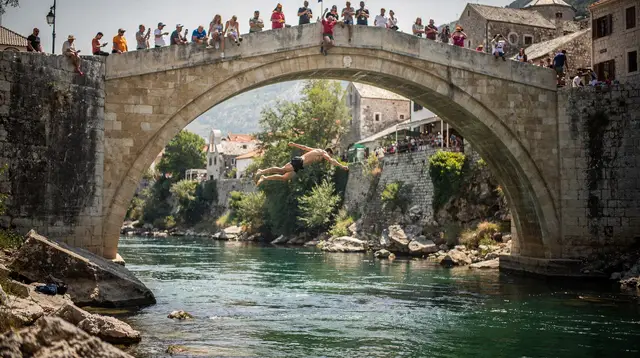
Photographing Mostar at Sunrise and Sunset: When to Show Up
What time should I go out to photograph Mostar in good light?
There is no fixed hour: sunrise and sunset shift by more than two hours between June and December, so plan around first light and last light for your travel dates rather than a clock time. Early morning at the Stari Most beats the tour-group rush, and a raised viewpoint works best in the hour before sunset.
Mostar rewards photographers who show up at the edges of the day, not the middle of it. The old town’s stone catches a completely different light at 7am than it does at 1pm, and the Stari Most looks like a different bridge from a raised viewpoint at dusk than it does from the deck at noon. What trips people up is not the idea of golden hour — most visitors already know to aim for morning or evening — it is the assumption that Mostar keeps the same schedule as home. It does not. This guide is about building your timing, not about which viewpoint or composition to use once you get there.
Why there is no single “best time” to give you
Sunrise and sunset times in Mostar swing by more than two hours across the year. Around the June solstice, the sun is up before 5am and does not set until close to 8:30pm. By December, sunrise slides past 7am and sunset arrives before 4:30pm. A photography plan built around “sunrise” or “golden hour” without checking the actual date is really a plan for whichever season you happened to visit in last, applied to a different one.
This matters twice over in Mostar specifically. First, the heat of Mostar summers means the useful soft-light window at each end of the day is short and sharp — the sun climbs fast and turns harsh within thirty or forty minutes of rising. Second, the shoulder seasons and winter stretch that window out: the light stays low and warm for longer, even though the days themselves are much shorter. So instead of memorizing a clock time, check sunrise and sunset for your actual dates a day or two before you shoot, and build your morning or evening around that number rather than a number from this page.
Morning: beating the crowd, not just the sun
The single most reliable piece of timing advice for the Stari Most has less to do with the sun’s exact position and more to do with tour buses. Coach groups arriving from the Adriatic coast, along with cruise-linked day trips, tend to reach the old town from mid-morning onward. The hour or so after sunrise is consistently the calmest stretch you will find on the bridge and in the lanes of Mostar’s old town — often the only time you will see the bridge deck close to empty.
That early window also happens to line up with the softest light on the facades either side of the river, since the sun is low and the old stone takes on warm, directional light rather than the flatter overhead glare of midday. The two things reinforce each other: the light is doing you a favor at the same time the crowds are doing you a favor, which is not always the case at sunset.
A practical note on logistics: if you are staying outside the immediate old town, work out how you’ll get there on foot or by local bus before your early start, since taxis and rideshare options are thinner at dawn than during the day. And if a short walk feels like the wrong start to an early morning, choosing a place to stay within walking distance of the bridge removes that variable entirely — you can be there in five minutes rather than planning around a ride.
Evening: raised ground over the bridge deck
Where morning favors the bridge itself, the evening window tends to favor height. As the sun drops, a raised vantage point looking down over the Stari Most and the Neretva picks up warm tones on the stone and the water that are harder to capture from bridge level, where the crowd also tends to build back up by evening as the day’s visitors linger for dinner and a last look at the town.
This page is not the place to work through which specific viewpoint suits which composition — a separate guide to Mostar’s best viewpoints covers that in detail. What matters here is the timing logic: aim to be in position on your chosen high ground twenty to thirty minutes before actual sunset, since the most useful light often falls in the run-up to the sun touching the horizon rather than at the exact listed minute, and it fades faster than it feels like it should once the sun is gone.
Mount Hum, the high point overlooking the city, is the most obvious of these raised options, reachable on foot for the fitter visitor or by road, and increasingly by a fixed via ferrata route for those who want the climb itself to be part of the outing.
a guided via ferrata route up Hum times the climb so you top out with time to spare before the light turns, rather than racing the sun on an unfamiliar route.
Building a golden-hour session instead of guessing
If timing this alone feels like more coordination than you want on a trip, a guide who already knows the seasonal light removes the guesswork on both ends: which spot works for that week’s sunset, and how much buffer to leave for reaching it.
a private golden-hour photography outing around Herzegovina is built around exactly this — a driver and guide who track the actual sunset for your dates rather than a generic hour, and who can adjust the plan on the day if cloud cover or a late afternoon storm shifts the useful window.
For a lighter, self-directed version of the same idea within town, renting a bike for a few hours lets you cover the ground between an early-morning bridge visit and a different vantage point for the evening without depending on taxi availability at odd hours — useful precisely because dawn and dusk are when transport options are thinnest.
A rough seasonal cheat sheet
Treat the table below as an order of magnitude to sanity-check against the actual sunrise and sunset time for your dates — not as a schedule to follow blindly.
| Season | Approx. sunrise | Approx. sunset | What that means for timing |
|---|---|---|---|
| June–July (peak summer) | ~5:00–5:30am | ~8:00–8:30pm | Short, intense light window either end of a long, hot day; early start rewarded most |
| April–May, September–October | ~6:00–7:00am | ~6:30–7:30pm | More forgiving light for longer, milder temperatures, fewer coach groups |
| November–March (winter) | ~6:30–7:30am | ~4:00–5:00pm | Low, soft light lingers longer relative to the shorter day, but daylight hours are limited overall |
The gap between summer and winter sunset alone is close to four hours — the kind of difference that turns “arrive at 7pm” from good advice in July into a plan to shoot in the dark come December.
Fitting a photography outing into a wider visit
None of this needs to dominate a trip. Most visitors treating photography as one part of a longer stay find it easiest to slot an early bridge visit or an evening viewpoint session around everything else they’re doing, rather than building a whole day around it. If you’re still working out how many days to give Mostar overall, a couple of well-timed sessions — one morning, one evening, on different days if your schedule allows — usually cover the light without needing extra time set aside.
For anyone building an entire trip around photography rather than fitting it in, a dedicated photography itinerary for the region sequences these sessions against the rest of Herzegovina rather than Mostar alone. And if the appeal is partly the ritual of the old town at dawn — watching the club’s divers prepare before the bridge fills up, or the market stalls setting up along the lanes — pairing your photography session with that slower start tends to work better than treating the two as separate errands.
For a longer view down over the town from a different angle, some visitors add a short session on the far side of the river during a wider circuit; a zip line crossing above the Neretva canyon gives an aerial vantage that is worth timing against the same evening light if it’s already part of your day, though it’s a one-pass experience rather than a spot to linger and reshoot the way a fixed viewpoint is.
The one habit worth keeping
If there is a single takeaway to carry past this page, it is this: check the actual sunrise and sunset time for your specific dates the day before you plan to shoot, rather than trusting a number from a blog post, a friend’s trip last year, or even the season you assume you’re in. Mostar’s light shifts fast across the calendar, and the plan that worked perfectly for someone visiting in July will put you in flat midday glare or complete darkness if you copy it in December. Everything else in this guide — the early start to beat the coaches, the raised viewpoint for evening, the buffer time before the actual moment of sunrise or sunset — only works once that one number is right for your week.
What the weather does to your plan
Sunrise and sunset times are only half the equation. Herzegovina’s summer afternoons can build into short, sharp storms that roll in off the surrounding hills with little warning, and a clear morning is no guarantee of a clear evening six hours later.
Cloud cover changes the character of the light more than it changes whether you should bother going out at all: a thin, high layer of cloud at sunset often produces a softer, more even wash of color across the old town’s stone than a completely clear sky does, while a heavy bank of cloud sitting right on the horizon can swallow the last twenty minutes of color before it even starts. Checking a short-range forecast the morning of your session, rather than relying on the general seasonal pattern, is worth the two minutes it takes.
This is one of the reasons a private, driver-led session has an edge over a fixed plan: a private golden-hour outing with a local guide can pivot to a different vantage point if the cloud bank sitting over one side of the valley is clearly going to ruin the light there, something you cannot do easily on foot with a fixed viewpoint in mind. If you are self-directing instead, treat your seasonal cheat sheet as the starting point and the actual sky that evening as the final word.
Wind matters too, more than most visitors expect. A breezy evening on Fortica’s glass skywalk or up on Hum can make a tripod-mounted long exposure of the river genuinely difficult, and it changes how dust and haze sit over the valley at the golden hour — a still evening tends to give clearer, more saturated color over distance than a gusty one, where fine dust kicked up from dry hillsides scatters the light and flattens contrast on anything more than a few hundred meters away.
Gear choices that actually matter for this light
You do not need specialized equipment to get a good result from either window, but a few choices make the raking light easier to work with. A polarizing filter earns its place in a way it rarely does at midday: cutting glare off the Neretva’s surface at both the morning and evening session reveals color and texture in the water that a straight shot loses to reflected sky.
A small travel tripod is more useful on a raised viewpoint than on the bridge itself — the Stari Most’s smooth, sloped stone deck is shared with pedestrians, cyclists and the diving club’s own routine, which makes a full tripod there impractical no matter the hour, a point covered from the access side by the guide to watching the club’s divers.
For anyone shooting through both sessions in the same trip, a longer lens pays off more at sunset than at sunrise: from height, compressing the old town’s rooftops and minarets against the warm sky rewards more reach than the wider compositions that tend to work better at bridge level in the morning. None of this needs to be expensive gear — a mid-range zoom and a lightweight tripod cover both scenarios without turning a photography session into a hauling exercise on an early-morning walk.
Extending the light beyond the bridge itself
Mostar is not the only place in the region where the same golden-hour logic applies, and visitors building a longer stay around photography often extend a single well-timed morning or evening into a wider circuit. Blagaj, with its dervish house sitting directly under the cliff face at the source of the Buna river, catches a similarly dramatic raking light in the hour after sunrise, before the day-trip buses from the coast arrive — the same crowd logic that applies to the Stari Most applies there almost exactly.
A combined day trip pairing Blagaj with Počitelj and Kravice is built around exactly this kind of early start, and photographers who want to fold more than one location into a single morning session tend to find it a natural add-on to a Mostar-based stay rather than a separate outing.
Počitelj’s stone terraces and the Gavrankapetanović tower hold warm light for longer into the evening than most spots along the river, thanks to their south-facing exposure on the hillside, and a guide comparing Blagaj and Počitelj as a one-day pairing is worth a look if you are deciding which one better fits an evening slot alongside a Mostar sunrise the same trip.
Further out, Kravice waterfalls photograph best at a different time of day entirely — the falls sit low in a bowl and lose direct light earlier than the exposed hilltop viewpoints around Mostar, so a guide to Kravice’s opening hours, prices and access is more useful there than a sunrise-or-sunset framework, and water levels change substantially by season in ways that affect the photograph as much as the light does.
Closer to town, the copper workshops of Kujundžiluk catch morning light down the length of the old bazaar lane before the day’s foot traffic fills it, and a slow walk through on the way back from an early bridge session — rather than a dedicated separate visit — tends to suit the same early-riser’s schedule.
Photographing the town’s other layers, not just the bridge
The Stari Most understandably dominates any conversation about Mostar photography, but the raking light at either end of the day does just as much for the town’s other visual layers, and a session built only around the bridge misses most of what makes the light interesting here. The bullet-scarred facades and shelled buildings that remain standing along parts of the old town read very differently in soft morning light than they do under flat midday sun, where the texture of damage tends to disappear into a uniform gray.
A guide to the visible war scars still standing in Mostar is worth reading before you go looking for these compositions, both for context and for which specific buildings are still accessible to photograph respectfully rather than as backdrop alone. The broader war memory sites across Herzegovina extend well beyond the town itself for anyone building a dedicated war memory itinerary around the region.
The Bulevar, Mostar’s old front line, holds a different kind of light interest: its long, straight run of still-damaged buildings catches a strongly directional low sun along its length in a way that a shorter, more enclosed street cannot, and the monument along it that most visitors walk straight past is easy to miss without knowing roughly where to look. Street art scattered through the old town and its surrounding neighborhoods also picks up better contrast and color saturation in the same early or late light that favors the stone facades, and a guide to Mostar’s street art maps out where most of it concentrates.
For photographers more interested in daily life than architecture or history, the hour around sunrise is also when the town’s morning routine is most visible and least self-conscious in front of a camera: market stalls setting up, the first coffee crowds gathering, the town waking up before the day-trip buses reshape the pace of everything. Learning the basics of how Bosnian coffee is actually served is a small piece of local color worth knowing before you sit down at one of these early-morning cafés with a camera on the table rather than tucked away.
Fitting a photography session around religious and cultural rhythms
Mostar and the wider region carry a visible religious layer that shapes both the light and the crowds at certain times of year. Medjugorje, a half-hour or so away, draws its own dawn and dusk crowds entirely independent of photography — pilgrims gathering for early prayer or evening apparitions rather than for the light itself — and a practical guide to visiting as a pilgrim or as a skeptic curious about the place is worth reading before folding it into a photography-focused itinerary, since the rhythm there runs on faith schedules rather than golden hour.
Religious holidays elsewhere in Mostar can also shift foot traffic at the mosques and around the Koski Mehmed-Paša Mosque in ways worth checking before you plan an early visit there specifically for photography, since access and appropriate behavior both change around prayer times.
Winter light: a different kind of session entirely
Most of this guide leans toward the longer, warmer months, but winter deserves its own note because the logic changes rather than just the numbers. With sunset arriving as early as 4pm, a Mostar visit built around the winter months compresses the whole day into a much tighter window, and a photography session has to compete directly with everything else you might want to do that day rather than bookending it.
The upside is real: winter’s low sun angle persists for longer relative to the shorter day, so the flattering raking light that summer gives you for perhaps thirty minutes can stretch closer to an hour in December, with far fewer other photographers and almost no coach traffic to work around. The tradeoff is cold, sometimes wet stone underfoot on the bridge deck and a much narrower margin for error if cloud cover rolls in and erases the one usable hour of light the day was going to offer.
Where you sleep changes what your morning looks like
The single biggest lever over how easy an early start feels is where you are staying the night before. Choosing accommodation within walking distance of the old town turns a 5am sunrise session from an operation — waking early enough to arrange transport, accounting for the fact that taxis and rideshare are thin on the ground before dawn — into a five-minute walk in whatever you slept in.
This matters more for photography than for almost any other activity in Mostar, since it is the one thing on most itineraries that genuinely requires being somewhere specific before the rest of the town is awake. If you are travelling as a family and weighing how a very early start fits with children, the guide to bringing children to Mostar is worth reading alongside this one before committing to a 5am wake-up for everyone.
Parking and access if you are not staying centrally
Not every visitor bases themselves inside the old town, and for anyone driving in for a dawn or dusk session rather than staying within walking distance, parking in Mostar is worth checking in advance — the old town’s narrow lanes are not built around private cars, and the closest parking to the bridge fills differently depending on the season and the day of the week. Arriving by car for sunrise avoids the thinner taxi availability that affects those without their own transport, but it trades that convenience for the walk in from wherever you can actually park, which is worth timing into your buffer alongside the light itself.
A short comparison: which session suits which kind of traveler
Not every visitor needs both sessions, and deciding between them — rather than trying to force both into a short stay — comes down to what you are actually there to photograph. A visitor mainly interested in the bridge itself, in the divers’ preparations, and in the old town’s lanes before they fill up is better served by the morning session alone, since that is where the crowd advantage is largest and the light on the facades is most useful.
A visitor more interested in the wider landscape — the river valley, the surrounding hills, the town as a single scene from height — gets more out of the evening session from a raised viewpoint, where the crowd advantage matters less than the quality of the color on the water and the stone. Visitors with only one early or late slot to spare across a short stay are usually better off picking based on this distinction rather than defaulting to sunrise simply because it is the more commonly recommended of the two.
For a longer stay where both sessions are realistic, alternating mornings and evenings across different days — rather than attempting a dawn-to-dusk marathon on a single day — tends to produce better photographs and a less exhausted traveler, particularly if the rest of your itinerary already has three days in Mostar or more built into it.
Frequently asked questions about photographing Mostar’s light
What time does the sun rise and set in Mostar?
It varies enormously by season, from roughly 5am sunrise and 8:30pm sunset around the June solstice to closer to 7:30am and 4:30pm in December. Check sunrise and sunset times for your exact travel dates rather than relying on a number you read once.
Is early morning really quieter at the Stari Most?
Yes. Day-trip coaches from Dubrovnik and Split, plus cruise-linked groups, tend to arrive from mid-morning onward. The hour or so after sunrise is consistently the calmest window on the bridge and in the surrounding lanes of the old town.
Is sunset or sunrise better for photographing the Stari Most?
Both work, for different reasons. Sunrise favors an empty bridge and soft frontal light on the old town facades; sunset favors a raised viewpoint looking down on the bridge as the stone and river pick up warm tones, though the bridge deck itself gets busier again by evening.
Do I need to arrive before actual sunrise or sunset?
Plan to be in position 20 to 30 minutes before the listed time. The most useful light for the old town often falls in the minutes just before and after the sun is on the horizon, not at the exact moment itself.
Does the season change more than just the clock time?
Yes. Summer light is intense and short in its useful window, with harsh midday shadows either side; winter light is lower and softer for longer, though the days themselves are much shorter and colder overall.
Can I shoot the bridge lit up after dark?
The Stari Most and its towers are illuminated after dusk, and the bridge stays reachable in the evening, but this page focuses on the raking-light window around sunrise and sunset rather than night photography technique.
Is a tripod allowed on the Stari Most?
There is no general ban, but the bridge surface is a smooth, sloped, and often wet stone deck used by pedestrians, cyclists, and the club’s divers, so a full tripod is impractical there. It is more useful once you are on a stable viewpoint away from the bridge deck itself.
How much time should I set aside for a photography outing around sunrise or sunset?
Budget at least 90 minutes to two hours: time to reach your spot before the light starts, the working window itself, and a buffer, since the best minutes of light are often shorter and less predictable than they look on paper.
Viewpoints and skywalk experiences on GetYourGuide
Verified deep-linked GetYourGuide tours. Book through these links and we earn a small commission at no cost to you.
GetYourGuide does not provide a product photo for this activity — the image shows the meeting point, photographed by us.