Visiting Mostar With Kids: A Family Travel Guide
Is Mostar a good destination for a family with kids?
Yes, with adjustments for summer heat: plan the Old Bridge and old town for early morning, save the middle of the day for swimming at Kravice or a boat ride at Hutovo Blato, and watch footing on the polished stones near the bridge.
Building a Family Itinerary Around Mostar’s Rhythm
Mostar rewards families who work with its climate rather than against it. The old town is compact, photogenic, and genuinely interesting to children who like bridges, boats, and the odd cannonball hole in a wall — but it is also stone, sun, and steps, with very little shade over the Stari Most and the lanes around it. The families who come away happiest are the ones who front-load the walking into the morning, treat the middle of the day as a swimming or shaded-activity window, and save any second round of sightseeing for early evening.
A useful mental model: two nights in Mostar itself gives a family enough slack to split the old town, a half-day at Kravice, and a slower morning without feeling rushed. If your trip is shorter, see how many days to budget for Mostar for the trade-offs of a tighter schedule. Families arriving from Dubrovnik or Split as a day trip can still make it work, but the driving time eats into the cooler hours at both ends, so an overnight stay usually suits children better than a single long day on the road.
Timing Days Around the Heat, Not Around the Clock
Mostar is the hottest city in Bosnia and Herzegovina. July and August afternoons average around 27-28°C, and heatwaves have pushed the mercury past 40°C for several days running at the local weather station. None of that is dramatic on paper, but it is very real for a six-year-old standing on sunlit stone with no shade in sight. Read the heat guide for Mostar in summer before you finalize a summer itinerary, and build every family day around three blocks:
- Early morning (before 10am): the Old Bridge, the old bazaar of Kujundziluk, and any walking-heavy sightseeing, while the stone is still cool and the crowds are thin.
- Midday to mid-afternoon: water. This is when Kravice, Hutovo Blato, or a hotel pool earns its keep — not a museum with no air conditioning.
- Late afternoon to sunset: a second, gentler round of sightseeing, or simply ice cream and people-watching along the river.
If you are visiting outside July-August, this pressure eases considerably; see when to come to Mostar month by month for how spring and early autumn compare for families who can be flexible on dates.
Kravice Falls: The Family Highlight
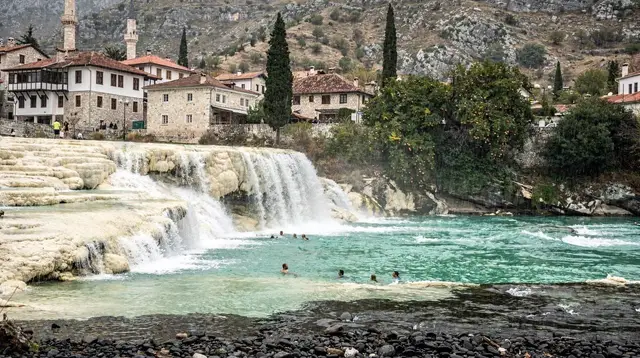
For most families, Kravice is the single best-loved stop in the region. The waterfalls are wide and gentle rather than a single dramatic drop, the lake below them is shallow enough near the banks for children to wade and splash, and the setting — a semicircle of cascades feeding a turquoise pool — photographs beautifully without any hiking required to reach it.
The catch is timing. Kravice draws over 200,000 tourists and another 50,000 local visitors over a single summer, and between 11am and 4pm in July and August, coach traffic from Dubrovnik and Split converges on the site: queues at the ticket booth, a full car park, and a crowded shoreline. None of that ruins a family visit, but it does mean the water is calmer, the shade under the trees easier to claim, and the whole experience more pleasant if you arrive before 11am or after 4pm, or visit in June or September rather than the peak weeks.
The full practical guide to Kravice — hours, entry fees, and access covers ticket costs and parking in detail; expect the entrance fee to run in the order of 10 euros for an adult, with a separate small parking charge, and treat both as approximate rather than fixed.
Pack water shoes if your children are sensitive to rocky lake beds, and bring a dry change of clothes for the drive back — nobody enjoys a 45-minute return trip in a damp car seat.
Hutovo Blato: A Gentle Boat Ride for Younger Children
If your children are too young for the walking-heavy old town, or you simply want a lower-key day, the wetland reserve near Hutovo Blato offers one of the calmest family activities in the region: a slow boat ride along shaded channels, watching herons, cormorants, and other waterbirds from a stable wooden boat. Life jackets are standard, the pace is unhurried, and there is no swimming component to supervise — which makes it an easy midday choice on a day when the heat rules out anything more active.
It pairs naturally with a morning at Capljina or a stop at the Roman-era villa of Mogorjelo nearby, letting you build a full day out of the Neretva valley without ever putting a child on hot, exposed pavement for long.
Getting Around: Cobblestones, Steps, and Strollers
Mostar’s old town was built centuries before anyone thought about wheels. The lanes around the Old Bridge are paved in smooth stone, often sloped, and interrupted by steps in more than one place — a stroller becomes more of a burden than a help here. A soft carrier for children under three, and simply holding hands with older children, works far better than trying to push a stroller across the bridge itself.
Outside the historic core, pavements are more conventional and a stroller is fine for getting between your accommodation and the old town’s edge. For a fuller picture of buses, taxis, and walking distances, see getting around Mostar on foot and by local bus. Families traveling with a wheelchair or a child who cannot manage steps should note that this guide focuses on family logistics rather than mobility access — the dedicated accessibility guide for Mostar covers step-free routes and facilities in more depth.
Mind the Slippery Stones Near the Old Bridge
One detail catches families off guard more than any other: the stone paving on and immediately around the Stari Most is genuinely slick. Centuries of foot traffic have polished the surface smooth, and it becomes noticeably more slippery when wet — from rain, from splashed water, or simply from condensation on a humid morning. Thin-soled sandals or flip-flops are the wrong footwear here; closed shoes with some grip make a real difference, both for adults carrying a child and for children walking on their own.
The bridge itself has a gentle but continuous slope up to its high point, and the parapet, while present, is not something to lean small children over for photos. If you plan to watch the traditional bridge divers, hold onto younger children firmly in the crowd that gathers at both ends — it is a popular spot and can get tightly packed, particularly in the hour before a scheduled dive.
Where to Stay With Children
Basing yourself inside or just outside the old town cuts down on transfer time for early-morning sightseeing, but it also means more foot traffic, later evening noise from riverside cafés, and those same slippery lanes right outside your door. Families with younger children, or anyone who values a quieter night’s sleep, often do better a short walk away from the immediate bridge area, close enough to reach the old town in ten minutes on foot but away from the densest crowds. The full guide to choosing a neighborhood in Mostar breaks down the trade-offs by area, including which parts of town put you closer to parking if you are driving in with car seats and luggage.
Air conditioning is worth confirming directly with any accommodation booked for a summer stay — not every older Mostar guesthouse advertises it clearly, and it matters far more with children in the room during a heatwave than it would for a couple.
What to Pack for a Family Day in Mostar
A few items make a disproportionate difference to how smoothly a family day goes here:
| Item | Why it matters |
|---|---|
| Closed, grippy shoes | Old town stone is polished smooth and slippery near the bridge |
| Reusable water bottles | Refill points exist, and dehydration risk is real in summer heat |
| Wide-brim hats and sunscreen | Little shade in the old town; strong Herzegovina sun even in shoulder season |
| Quick-dry swimwear under clothes | Saves a change of clothes trip before Kravice |
| Small bills in KM | Entry fees at Kravice, Blagaj, and museum-houses are cash-friendly and rarely accept cards |
| A soft carrier, not a stroller | Steps and sloped stone around the Old Bridge favor carrying over wheeling |
On money: the mark convertible (KM) is Bosnia and Herzegovina’s currency, fixed to the euro at 1.95583 KM per euro under a currency board arrangement that has not changed since 1997. Euros are often accepted in tourist-facing shops, but change usually comes back in KM, so carrying some local cash avoids awkward moments at a ticket booth in the middle of a hot afternoon.
A Sample Family-Friendly Day
- 7:30-9:30am: Walk the old town and Stari Most while it’s cool, watch a scheduled bridge dive if timing allows, browse the coppersmith stalls of Kujundziluk.
- 10:00am: Drive out toward Kravice, aiming to arrive before the coach crowds build.
- 10:30am-1:30pm: Swim, wade, and picnic at Kravice, retreating to shade as needed.
- 2:00-3:30pm: Late lunch and a rest back at accommodation, or a slower stop such as Blagaj and its riverside tekija if energy allows.
- 6:00-7:30pm: A relaxed second walk through the old town in the cooler evening light, dinner by the river.
This same shape scales up or down: swap Kravice for the boat ride at Hutovo Blato on a lower-energy day, or extend it into the two-day Mostar itinerary or the dedicated family itinerary for Mostar if you want a fuller day-by-day plan already built around these same constraints.
Family-Friendly Activities Worth Booking
A handful of bookable activities suit families particularly well because they are short, low-risk, and genuinely enjoyed by children rather than tolerated by them.
A guided day at Boračko Lake, with time for swimming and a calm mountain-lake setting gives families an alternative to Kravice on a day when you’d rather avoid the crowds, with a guide handling the driving and logistics. For families who want gentle, low-effort activity together, renting bikes in Mostar for a flat, easy ride along the river works well with children old enough to pedal on their own or ride in a child seat.
Older children who enjoy a bit of harmless thrill can try the glass bridge and zip line experience above Mostar, a short, supervised activity rather than anything approaching the technical via ferrata routes nearby. And for a slower, food-focused half-day that works for the whole family, an olive oil tasting paired with local heritage bites introduces children to regional food in a relaxed, seated setting rather than a long walking tour.
None of these substitute for the free, unbookable core of a family trip here — the bridge, the old town, a swim at Kravice — but they fill in the gaps on a second or third day nicely, especially if the heat has made you wary of another unstructured walking day.
Frequently Asked Questions About Visiting Mostar With Kids
Is Mostar’s old town stroller-friendly?
No. The old town is paved in smooth, sloped stone and cut by steps around the Old Bridge, so a lightweight carrier or a child who can walk short distances works better than a stroller for that part of the visit.
What is the best age for kids to enjoy Mostar?
Most families find Mostar rewarding from around age five upward, once children can manage some walking in the heat and appreciate a swim break; toddlers can still visit but need more shade breaks and a carrier rather than a stroller.
Is Kravice safe for children to swim at?
Yes, in the marked shallow areas near the shore, though there is no lifeguard, the lake bed shelves off quickly in places, and July-August crowds make close supervision essential; arrive before 11am or after 4pm for calmer water.
Can young children do the Hutovo Blato boat trip?
Yes, the wooden boats used on the wetland channels are slow and stable, life jackets are provided, and the ride suits children who enjoy watching birds and water rather than fast-paced activity.
How hot does it get in Mostar in summer, and does that matter for kids?
Mostar is the hottest city in Bosnia and Herzegovina, with July-August afternoons regularly near 27-28°C on average and spikes above 40°C during heatwaves, so midday outdoor sightseeing with children is genuinely uncomfortable and best avoided.
Are the stones near the Old Bridge slippery?
Yes. Centuries of foot traffic have polished the stone slabs on and around the Old Bridge into a smooth, sometimes slick surface, especially when wet or in thin-soled sandals, so grippy shoes and a firm hold on smaller children’s hands matter here.
Does Mostar work as a day trip or an overnight stay with kids?
An overnight stay is easier on a family’s schedule than a single long day trip from the coast, since it lets you split sightseeing and swimming across cooler morning and late-afternoon hours instead of cramming everything into the hottest part of the day.
Wildlife and nature tours on GetYourGuide
Verified deep-linked GetYourGuide tours. Book through these links and we earn a small commission at no cost to you.
GetYourGuide does not provide a product photo for this activity — the image shows the meeting point, photographed by us.