Mostar Old Town Guided Tour: What to Expect
What does a guided tour of Mostar's old town actually cover?
A typical guided walk covers the Stari Most viewpoints, the Kujundžiluk bazaar, the Koski Mehmed-Paša Mosque and one or two Ottoman houses, usually in 1.5 to 2.5 hours. It stays inside the old town and does not include Blagaj or Počitelj, which are separate half-day excursions.
What a Guided Walk Through the Old Town Actually Covers
Booking a guided tour of Mostar’s old town settles the “what should I see” question before you arrive, but it helps to know the shape of the walk in advance: where it starts, what it stops at, and how the pieces connect. This page describes that shape. It does not weigh guided against independent visits (that comparison lives on Guided Tour or Independent Visit to Mostar?), and it does not go deep on any single monument, each of which has its own page: Stari Most, kujundziluk, and Koski Mehmed-Pasha Mosque. What follows is simply what to expect once you’ve already decided to go with a guide.
The route, in order
Almost every operator runs the same core loop, because the old town is compact and the sites sit close together. A typical route looks like this:
- A meeting point near Mostar, often close to Spanish Square or one of the main pedestrian entrances to the old town.
- A walk down toward the The Bulevar & the Front Line, where guides usually pause to explain how the 1992-1995 front line ran along this avenue rather than along the river, before continuing into the old stone alleys.
- Approach to the stari-most itself, with time at both riverbanks for the classic photo angles and an explanation of the 1566 construction, the 1993 destruction, and the 2004 reconstruction using Ottoman-era techniques.
- A walk through kujundziluk, the cobbled copper bazaar that has sold hammered metalwork since Ottoman times, with a stop to watch or try the craft described on Copper Craft in Kujundžiluk.
- A visit to the Koski Mehmed-Pasha Mosque, usually including the courtyard and, for those who choose it, the narrow minaret staircase for a view over the rooftops and the bridge.
- A stop at one, occasionally two, Ottoman-era houses, most commonly Biscevic or Muslibegovic, covered together on Bišćević House vs Muslibegović House.
Some itineraries add a short detour toward the Partisans’ Memorial Cemetery, Mostar or a viewpoint on the way back, but these are extras rather than the standard route, and not every operator includes them.
Where the tour starts and ends
Most walking tours begin at a fixed meeting point in or near Spanish Square, at the edge of the pedestrian old town, since this is where cars can still get relatively close and where groups are easy to spot. From there the walk is entirely on foot, on cobblestones that are uneven and can be slippery when wet, so flat, closed shoes matter more than they might seem to before arriving.
The tour usually ends either back at the starting point or at the far side of the Stari Most, leaving you free to wander the alleys on your own afterward. Guides commonly suggest lingering for lunch or a coffee once the formal walk wraps up, since the group pace rarely allows time to sit down along the way.
The historical thread that ties the stops together
What separates a guided walk from wandering with a map is less the list of stops than the thread a guide draws between them. The old town’s Ottoman architecture, the bridge, the mosque, the houses, all date from the same 15th-to-16th-century period of Ottoman expansion into Herzegovina, and a guide typically explains how this heritage sits alongside two later ruptures: the Austro-Hungarian period that added its own layer to the city, and the 1992-1995 war that destroyed the bridge and divided the city along the Bulevar rather than along the river.
This is also where guided tours tend to add the most value over independent visits: connecting a stone house or a mosque courtyard to the century it was built in, and connecting the bridge’s 2004 reopening to the reconstruction effort that used the same stone and the same building techniques as 1566, is exactly the kind of context that a plaque alone rarely conveys. For a page dedicated to the war years themselves rather than the old town route, see Understanding Mostar’s 1992–1995 War and Reading the War’s Scars in Mostar’s Streets.
Group, private, and evening formats
The route above stays broadly the same regardless of format, but the experience around it differs.
| Format | Typical length | What changes |
|---|---|---|
| Small group, daytime | 1.5-2 hours | Fixed schedule, shared pace, lower price per person |
| Private, with local guide | 2-2.5 hours | Flexible pace and language, can skip crowded stretches, higher price |
| Evening tour | 1.5-2 hours | Starts after the afternoon heat and coach crowds ease, softer light for photos |
A group walking tour such as a guided outing through the old town is the most common way to see this route, run on a fixed schedule at a set price per person. For a slower pace or a different starting point, a private walk with a local guide covers the same stops but lets you linger at whichever one interests you most, or add extra context on the war years or the craft traditions along the way.
Because Mostar is the hottest city in Bosnia-Herzegovina in summer, with July and August afternoons regularly above 30 degrees, some operators shift the same walk into the evening. An evening walk through the old town follows a similar route once the midday heat and the coach-tour crowds around the bridge have thinned out, with the stone alleys lit differently as the light fades.
A related route starting from the square above the old town is a walk down from Spanish Square to the bridge, which frames the same stops as a single descent from the newer part of town into the Ottoman core.
What isn’t part of this tour
It’s worth being explicit about the boundary, because it’s the most common source of mismatched expectations: a guided old town tour stays inside Mostar itself. It does not reach Blagaj and its tekija on the Buna spring, or Pocitelj’s Ottoman fortress, both of which sit outside the city and are covered by separate half-day excursions. If either of those is the priority, look at a combined outing rather than expecting the old town walk to stretch that far; Blagaj or Počitelj compares the two directly. The old town walk also generally does not include Kravice, Medjugorje, or the surrounding hills such as Hum Hill, all of which are their own trips.
Entrance fees during the tour
Guides walk the group to the mosque and the Ottoman houses, but entrance tickets are frequently handled separately from the tour price and paid on the spot, in Bosnian Mark (KM). The mosque’s minaret climb, in particular, is often ticketed apart from the courtyard entry. Because the exact arrangement varies by operator, it’s worth confirming before booking whether tickets are included or paid locally, and bringing small KM notes either way since card payment is not reliable at every entrance.
Practical notes for the day
Cobblestones, sun, and crowds are the three things that shape how a walk through the old town actually feels, more than the list of stops itself. Summer sun is intense with very little shade once you’re off the main covered bazaar lane, so water and a hat matter even for a two-hour walk. Midday, especially between roughly 11am and 4pm in July and August, is when day-trip coaches from Dubrovnik and Split cluster around the bridge, so a morning or evening slot generally means more breathing room at the viewpoints. None of this affects safety inside the old town itself, which is fully paved and monitored; the mine-risk areas that exist elsewhere in rural Herzegovina are not a concern on this route.
For a broader sense of how much time the old town deserves against the rest of the region, How Many Days Do You Need in Mostar? and the Two Days in Mostar itinerary both build outward from this same core walk. Photographers timing the light around the bridge specifically will find more detail on Mostar’s Best Viewpoints and the The Mostar Photography Itinerary.
Choosing between the operators running this route
Because so many companies sell essentially the same loop, the differences that matter tend to be group size, language, and whether the guide leans harder on the war history or the Ottoman architecture. A guide trained mainly in the Ottoman period will spend longer inside Koski Mehmed-Pasha Mosque and the Ottoman houses; one who came up through the post-war years will spend more time at the The Bulevar & the Front Line and point out shrapnel scars on building facades that a purely architecture-focused walk might skip past entirely.
Neither approach is wrong, but it’s worth asking a booking agent or reading recent reviews to see which emphasis a given operator leans toward before committing. Scams and Tourist Traps in Mostar is also worth a quick look before handing over cash on the day, since a handful of unlicensed guides work the crowd around Spanish Square and the bridge, and a legitimate operator will always have a confirmed booking reference rather than asking for payment on the spot.
The broader question of whether to hire any guide at all, rather than which one, is covered separately on Guided Tour or Independent Visit to Mostar? and, from the angle of cost rather than content, on Mostar Budget and What a Day in Mostar Actually Costs, Ticket by Ticket. For travellers deciding between a private driver for the whole day and a walking tour booked separately, Private Transfer and Personal Guide for a Multi-Stop Day in Herzegovina lays out how the two options combine, since a driver typically drops you at Spanish Square and picks you up afterward rather than walking the old town itself.
What a guide adds that a plaque doesn’t
The single biggest gap between a self-guided walk and a guided one shows up at the stari-most itself. A sign at the bridge will tell you the years — built 1566, destroyed 1993, reopened 2004 — but a guide usually fills in what those years actually meant on the ground: how the original bridge was designed by the Ottoman architect Mimar Hajruddin under Suleiman the Magnificent, how the 1993 shelling that brought it down happened during the Bosnian War’s Croat-Bosniak conflict phase rather than the earlier Serb siege, and how the reconstruction team quarried stone from the same local source and relearned Ottoman-era mortar techniques rather than using modern concrete.
That distinction — old war versus older war, and old stone versus new-old stone — is exactly the kind of layered fact that guided walks exist to untangle, and it connects directly to the deeper background on Understanding Mostar’s 1992–1995 War and The Battle of the Neretva (1943) and the 1992–1995 War, which separates the WWII Battle of the Neretva from the 1990s conflict that this walk’s front-line stop actually refers to.
A similar layering applies inside kujundziluk. Without context, the bazaar reads simply as a row of souvenir stalls selling hammered copper plates and cezve coffee pots. With a guide, it becomes clear that this is one of the last working examples of an Ottoman craft guild street in the region, where coppersmiths still shape metal by hand using techniques passed down through families rather than imported machinery, a detail expanded on Copper Craft in Kujundžiluk. Guides commonly point out which stalls still hand-hammer their stock on site versus which sell imported pieces, a distinction that matters if buying a souvenir is part of the plan.
Photography along the route
Because the walk moves at a fixed pace, photographers with strong opinions about light sometimes find the schedule frustrating: the group arrives at the bridge whenever the itinerary says so, not when the light is best. The two viewpoints most guides stop at — the riverbank just downstream of the bridge and the small platform on the west bank — are covered in more depth, with specific times of day, on Mostar’s Best Viewpoints and Photographing Mostar’s Old Town By Day, and travellers building a trip specifically around photography may prefer to follow the dedicated The Mostar Photography Itinerary instead of, or in addition to, a standard guided walk.
An evening slot such as the evening walk through the old town tends to suit photographers better than a midday group tour, since the softer light lines up with when the walk actually happens rather than requiring a separate return visit.
Combining the old town walk with a day trip
Because the guided walk described here stays entirely inside Mostar, most visitors pair it with at least one half-day excursion into the surrounding countryside on a different day, or occasionally the same afternoon if the tour runs in the morning. The most common pairing sends travellers to kravice and either blagaj or pocitelj, an itinerary spelled out on Blagaj, Počitelj and Kravice in One Day and The Best Day Trips from Mostar, Compared.
Travellers with a religious or spiritual interest sometimes swap Blagaj for medjugorje, covered on Međugorje and Kravice and, for those approaching the pilgrimage site skeptically rather than devotionally, Medjugorje for the Unconvinced.
Travellers arriving on a day trip from the coast, rather than staying overnight in Mostar, generally slot this same old town walk into the middle of their day, between arrival and departure. One Day from Dubrovnik to Mostar and A One-Day Trip from Split to Mostar both build around exactly this core loop, and The Dubrovnik Day Trip Tradeoff discusses honestly how much of the old town a coach-tour schedule actually leaves time for compared to staying a night. Those coming instead from Kotor or Makarska will find the same logic applied on Long Weekend from Kotor and A Long Weekend in Mostar from Makarska.
Food and coffee after the walk
Since the formal tour rarely allows time to sit down, most guides end the walk near a cluster of restaurants and coffee stands rather than far from one, and a stop for cevapi or a slow Bosnian coffee is the natural next step once the group disperses. Where to Eat in Mostar, Neighborhood by Neighborhood and Ćevapi, Burek and Ašćinica cover what to order, and Bosnian Coffee in Mostar explains the ritual of the copper džezva and sugar cube that can otherwise seem baffling to a first-time visitor watching a table of locals take twenty minutes over one small cup. For a lighter and more symbolic read on what the local food scene says about the city’s identity, Ćevapi Diplomacy is worth a detour.
Language, tipping, and small logistics
Guides on this route typically work in English as standard, with German, Italian, or French available on request from larger operators, and a private booking such as a private walk with a local guide is the more reliable way to secure a specific language rather than hoping a group slot happens to match. A handful of useful phrases beyond English still go a long way with stallholders in kujundziluk, and Useful Bosnian Words and Phrases for Visitors to Mostar lists the basics worth learning before arrival.
On tipping, guided walking tours generally follow the same informal norms as the rest of the country’s tourism sector, and Tipping in Bosnia and Herzegovina sets out what’s typical for a guide versus a driver or a restaurant server. Currency is another recurring point of confusion, since Bosnia uses the convertible mark rather than the euro despite its proximity to Croatia and Montenegro; Money and Payments in Bosnia-Herzegovina and The Currency Nobody Warned You About cover what to have on hand for the entrance fees mentioned earlier in this guide.
Accessibility and mobility on the route
The old town’s cobblestones, the narrow minaret stair inside the mosque, and the uneven stone alleys around kujundziluk make this one of the more physically demanding short walks on offer in Mostar, even though its total distance is modest. Travellers with mobility limitations, or those bringing a wheelchair or a stroller, should read Accessibility in Mostar for Limited Mobility before booking, since several of the standard stops, including the minaret climb, are simply not accessible regardless of which operator is chosen.
Families travelling with young children face a milder version of the same issue, mainly heat and pace rather than terrain, and Visiting Mostar With Kids has notes on managing a guided walk with kids in tow, alongside the dedicated Mostar with Kids for a slower version of the same day.
Seasonal differences on the same route
The route itself does not change with the seasons, but the experience of walking it does. Winter visits mean thinner crowds and a guide who can slow down at each stop, at the cost of shorter daylight hours and occasionally icy cobblestones near the riverbanks; Mostar in Winter covers what to expect. The shoulder months of spring and autumn are when most repeat visitors recommend booking this walk, and Mostar in April, May and October explains why.
High summer brings the heat already mentioned above along with its own crowd patterns, detailed further on Summer Heat in Mostar and, for a first-hand account of just how uncomfortable an August walk can get, Mostar in August and Kravice in August for those pairing the old town with a same-day swim.
Whichever format and season is chosen, the underlying route rarely changes: it is short enough to repeat, detailed enough to reward a second pass with a different guide, and specific enough in what it covers that knowing its shape in advance, as laid out above, tends to make the hour or two spent walking it considerably more useful.
Frequently asked questions about touring Mostar’s old town with a guide
How long does a guided old town tour of Mostar last?
Most walking tours of the old town run 1.5 to 2.5 hours, covering the Stari Most, Kujundziluk and one or two Ottoman-era buildings at a walking pace with stops for photos and explanations.
What does a typical Mostar old town tour include?
Expect a route from a central starting point to the Stari Most, a walk through the Kujundziluk copper bazaar, a stop at the Koski Mehmed-Pasa Mosque, and usually one Ottoman house such as Biscevic or Muslibegovic. Entrance tickets to the mosque and houses are sometimes extra, so check what the tour includes before booking.
Does a guided old town tour include Blagaj or Pocitelj?
No. Blagaj, with its tekija on the Buna spring, and Pocitelj’s fortress are separate half-day excursions outside Mostar, usually combined with Kravice or Medjugorje. An old town tour stays within walking distance of the Stari Most.
Is a private tour better than a group tour for the old town?
A private guide can adapt pace and language and skip crowded stretches, while a group tour is cheaper and runs on a fixed schedule. Both cover the same core sites; the choice comes down to budget and flexibility rather than what you get to see.
Do I need to pay separate entrance fees during the tour?
Often yes. Guides typically walk you to the mosque, the minaret and the Ottoman houses, but entrance tickets for each are commonly paid on the spot in KM, separate from the tour price. Confirm this detail when booking.
What’s the best time of day for a guided old town tour?
Morning tours avoid the worst heat and the midday coach crowds around the bridge. Evening tours are a common alternative in summer, timed after the afternoon peak when the stone alleys have cooled down.
Can I see the bridge divers on this tour?
Divers from the Mostari club perform through the day when conditions allow, so a guide may point them out if a jump happens to take place, but it isn’t a scheduled part of the itinerary and isn’t guaranteed on any given visit.
Old Bridge (Stari Most) and Old Town tours on GetYourGuide
Verified deep-linked GetYourGuide tours. Book through these links and we earn a small commission at no cost to you.
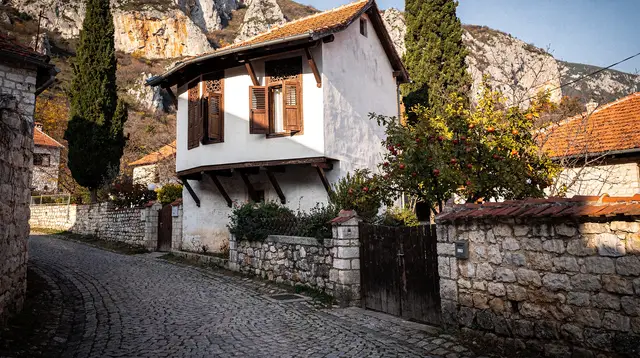
GetYourGuide does not provide a product photo for this activity — the image shows the meeting point, photographed by us.