Understanding Mostar's 1992–1995 War
Why does the 1992-1995 war still matter for a visit to Mostar?
The war split Mostar along the Bulevar, the avenue running east-west through the city, not along the Neretva river as many visitors assume. Bosnia and Herzegovina's Dayton Agreement ended the fighting in 1995 but froze many local institutions along ethnic lines, and Mostar remains administratively divided today without a single city assembly. Understanding this before you walk the streets makes sense of scars that are otherwise easy to misread.
A city that reads differently once you know its recent history
Most visitors arrive in Mostar knowing one fact about its war: that the Old Bridge was destroyed and rebuilt. That’s true, but it’s a small part of a larger story, and walking the old town without the rest of the context means missing what’s actually in front of you. The line that split this city in the 1990s wasn’t the river everyone photographs — it was an ordinary-looking avenue a few blocks back from it, and the consequences of that division are still part of how Mostar is run today. This page lays out the background: how the fighting started, why it fell where it did, what the peace agreement that ended it actually froze in place, and what all of that means for a visitor walking the streets in 2026.
None of this is meant to turn a trip to Mostar into a single-subject visit. The Ottoman old town, the Neretva canyon, the wine country around Citluk, and day trips to Kravice or Medjugorje are reasons to come here on their own terms. But the war is not background noise you can skip either — it shaped the city’s geography, its institutions, and a fair amount of what you’ll see and be told once you’re here.
How Yugoslavia came apart
Bosnia and Herzegovina was one of six republics of the Socialist Federal Republic of Yugoslavia, a multi-ethnic state held together for decades under Josip Broz Tito. After Tito’s death in 1980 and the political and economic strains of the following decade, Yugoslavia’s constituent republics began asserting independence one after another in the early 1990s: Slovenia and Croatia in 1991, then Bosnia and Herzegovina in 1992, following a referendum that was itself boycotted by much of the Bosnian Serb population.
Bosnia and Herzegovina’s population was famously mixed — Bosniak, Serb, and Croat communities lived interwoven across the country, including in Mostar, and the republic had no single majority. That mixture, which for decades had been a matter of everyday coexistence, became the fault line along which the war was fought once Yugoslavia’s collapse turned political disagreement into armed conflict. The war that followed in Bosnia and Herzegovina from 1992 to 1995 is usually remembered internationally through Sarajevo’s long siege and the atrocities in eastern Bosnia, but Mostar had its own, distinct wartime trajectory, fought in overlapping phases rather than a single continuous siege.
Mostar’s war in two phases
Mostar’s fighting broke down roughly into two periods. In 1992, Bosniak and Croat forces fought together against the Yugoslav National Army and Bosnian Serb forces, who shelled the city from the surrounding hills. That alliance did not hold. Through 1993, fighting broke out between former allies — Bosniak and Croat forces — turning the city into a front line running through its own center, with a period of siege conditions in the city’s east that lasted for roughly nine months. It’s this second phase, of former neighbors and allies fighting each other block by block, that left the deepest and most enduring marks on the city, including the destruction of the Old Bridge.
A ceasefire and, eventually, the Washington Agreement of 1994 ended the Bosniak-Croat conflict and set the framework for a Bosniak-Croat federation, ahead of the wider Dayton Agreement that ended the war countrywide in late 1995. But by the time the guns fell silent in Mostar, the city’s physical and institutional geography had already been redrawn.
The line that actually split the city
This is the detail visitors get wrong most often: the front line through Mostar did not run along the Neretva, the river that visually divides the city into an eastern and western bank and that every postcard photograph frames. It ran along the Bulevar, the avenue that crosses the city from east to west, a few blocks back from the river on the western side. For the better part of a year, this ordinary city street was the boundary between communities under fire from each other, and its buildings absorbed the war’s damage in a way the riverside old town, restored and photogenic, no longer visibly shows.
The distinction matters because it corrects an easy but wrong mental map. If you assume the river was the dividing line, you’ll misread which neighborhoods carry which history, and you’ll likely miss the Bulevar itself, which — as one of the city’s most tangible physical reminders of the war — is worth seeing precisely because it looks so unremarkable at first glance. It has its own dedicated page on this site, and a guided war heritage walk is the easiest way to have it pointed out and explained rather than walked past.
The Old Bridge, and what its destruction meant
The Stari Most, the Ottoman-era bridge built in 1566 on the orders of Suleiman the Magnificent, stood for 427 years before it was destroyed by shelling on 9 November 1993 — deliberately, in the middle of the same phase of fighting that split the city along the Bulevar. Its destruction became one of the most widely reported single images of the Bosnian war internationally, in part because the bridge had stood for so long as a shared symbol of the city rather than of one community within it.
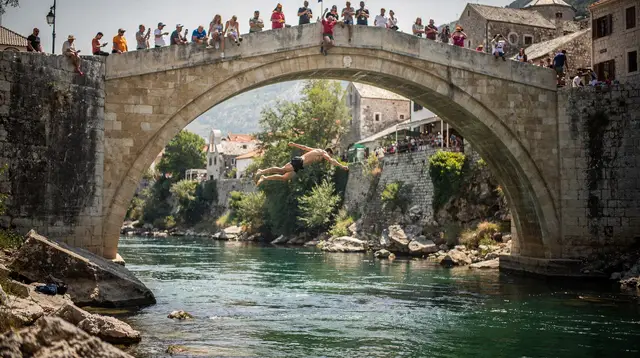
Its reconstruction, using original Ottoman techniques and matching stone, was completed over the following decade, and the rebuilt bridge reopened on 23 July 2004. In 2005, the bridge and the historic center around it were inscribed on the UNESCO World Heritage List — a recognition of the reconstructed site and the surrounding old town together, not of the original medieval structure alone, since that no longer existed. Today, seeing the Old Bridge and its famous divers is one of the most straightforward things to do in Mostar, and it doesn’t require any of this background to enjoy. But knowing what stood there before, and why, changes what the bridge is actually a monument to.
Dayton, and the peace that froze the division
The Dayton Agreement, signed in late 1995, ended the wider Bosnian war and established the country’s current constitutional structure: two entities, the Federation of Bosnia and Herzegovina and Republika Srpska, with a complex power-sharing system layered on top. Mostar itself, sitting within the Federation, ended up as something of a special case even by Bosnian standards — a city whose local institutions took years longer than most to reunify formally, and some of which, like a single unified city council, only saw sustained resolution well after most of the rest of the country had settled into its postwar arrangements.
The practical result, still visible today, is a city that functions but that has long run parallel structures in places — separate school curricula and, for years, largely separate civic and associational life organized along communal lines. This isn’t presented on the ground as a crisis, and it isn’t one you’ll be confronted with as a tourist walking between the old town and Kujundziluk. But it is real, it is a direct legacy of how the war ended rather than just how it was fought, and it’s the reason guidebooks and locals alike are careful never to call Mostar simply “reunified.”
What this means for a walk through the city
None of this requires treating a visit to Mostar as a tour of grief. Most of what you’ll do here — crossing the Old Bridge, browsing the copper stalls of Kujundziluk, climbing the minaret at the Koski Mehmed-Pasa mosque, watching the divers — sits comfortably apart from the war’s history, and most Mostar locals working in tourism will talk about their city in exactly those terms unless you ask otherwise.
But a short list of things is worth carrying with you as context rather than treating as separate trivia:
- The riverside old town you’re standing in was largely spared compared to the Bulevar corridor further back — restoration funding and international attention concentrated here first.
- Buildings along and near the Bulevar carry visible shell and bullet damage that has been left rather than repaired, in some cases deliberately, as a form of memory.
- The Partisan Memorial Cemetery, a striking terraced monument from the Yugoslav era, has its own separate history — it commemorates Second World War partisans, not the 1990s war, and was itself damaged and later restored after years of neglect following the 1990s conflict. It’s easy to conflate the two wars at this site; they aren’t the same one.
- Museums and exhibitions around town, including small private collections, present photography and testimony from the siege years — worth an hour if the subject interests you, entirely skippable if it doesn’t.
A note on two different wars
Herzegovina’s 20th-century history includes two conflicts that get mixed up surprisingly often, partly because they share some of the same geography. The Battle of the Neretva in 1943 was a Second World War engagement between Yugoslav Partisans and Axis forces, fought partly along the same river valley and commemorated today at a museum in Jablanica. It has nothing to do with the 1992-1995 war beyond sharing a river and a region. If you’re planning to visit sites related to either conflict, it’s worth keeping the two straight before you go, since some plaques and museum labels assume you already know which war they’re referring to.
Key dates at a glance
| Date | Event |
|---|---|
| 1980 | Death of Josip Broz Tito |
| 1991 | Slovenia and Croatia declare independence from Yugoslavia |
| 1992 | Bosnia and Herzegovina declares independence; war begins, including the siege of Mostar by Yugoslav/Bosnian Serb forces |
| 1993 | Fighting breaks out between former Bosniak-Croat allies in Mostar; the Old Bridge is destroyed on 9 November |
| 1994 | Washington Agreement ends the Bosniak-Croat conflict, establishes the Bosniak-Croat federation |
| 1995 | Dayton Agreement ends the wider Bosnian war and sets the country’s current constitutional structure |
| 2004 | The rebuilt Stari Most reopens on 23 July |
| 2005 | The Old Bridge and Mostar’s historic center are inscribed as a UNESCO World Heritage Site |
Visiting this history in practice
If you’d rather have this context explained on the ground than read cold, a guided walk is the most efficient way to see it. A guided war heritage walking tour through Mostar typically covers the Bulevar corridor, wartime damage still visible on building facades, and the Old Bridge’s destruction and reconstruction, with a local guide able to answer the follow-up questions a plaque can’t.
For a broader thematic framing that places Mostar’s war within the larger collapse of Yugoslavia, a thematic tour on the death of Yugoslavia based in Mostar goes further into the political background covered above.
Travelers basing themselves in Mostar for a few days sometimes pair this with a day trip north: a full-day tour to Sarajevo that includes the Tunnel of Hope museum extends the same period’s history to the siege of the capital, a very different wartime experience from Mostar’s front-line division. Closer to town, near Konjic, a tour combining Mostar’s highlights with Tito’s Cold War-era bunker adds the Yugoslav-era backdrop against which the 1990s breakup happened, rather than the war itself.
None of these are necessary to enjoy Mostar. Plenty of visitors spend a happy day or two here focused entirely on the bridge, the old bazaar, and the food, and that’s a perfectly good way to see the city. But if you want to understand what you’re looking at rather than just photograph it, an hour or two spent on this history — on a guided walk or simply reading before you land — changes what a walk down an ordinary-looking avenue a few blocks from the river actually shows you.
Planning around this side of Mostar
A few practical notes if war history is a priority for your visit rather than a footnote to it. Give it time: the Bulevar and its surrounding streets reward slow walking rather than a rushed pass-through, and pairing it with the old town walking tour in the same outing tends to work better than treating them as separate trips. If you’re deciding how much of your stay to give this subject versus everything else Mostar offers, it’s worth reading through how locals frame the balance between excursion and longer stay and how many days a reasonable Mostar visit actually needs.
For a structured way to build war history into a wider Herzegovina trip, the war memory itinerary lays out a multi-day version that also takes in Sarajevo. And if the subject of Bosnia’s wartime landscape interests you beyond Mostar itself, a longer read on wartime remnants still visible in the city and a practical guide to war memory tourism across Herzegovina go further than this page’s overview.
One safety note worth repeating here rather than assuming you’ve seen it elsewhere: none of this history extends to a general risk from unexploded ordnance in the city itself. Contamination in Bosnia and Herzegovina is concentrated in rural, forested, and mountainous terrain, not in Mostar’s streets, its paved roads, or its waymarked walking routes — see the dedicated guide to safety and landmines in rural areas if you’re also planning any hiking or off-trail time elsewhere in Herzegovina.
War history and remembrance tours (1992-1995 conflict) on GetYourGuide
Verified deep-linked GetYourGuide tours. Book through these links and we earn a small commission at no cost to you.
GetYourGuide does not provide a product photo for this activity — the image shows the meeting point, photographed by us.