Mostar in Half a Day: The Essential Walk
What can you realistically see in Mostar in half a day?
In three to four hours you can cover the Stari Most, the Kujundžiluk bazaar and the Koski Mehmed-Paša Mosque with its minaret. Aim for early morning or late afternoon in July-August, when midday crowds on the bridge slow everything down.
The three stops that actually matter
If you only have a few hours in Mostar - a coach transfer from Dubrovnik, a stopover before a bus to Sarajevo, a cruise-adjacent excursion from Split - you do not need a full-day plan. You need three stops, walked in the right order, at the right time of day: the Stari Most, the old bazaar of Kujundžiluk, and the Koski Mehmed-Paša Mosque with its minaret. All three sit within a five-minute walk of each other on the east bank of the Neretva, which is exactly what makes this route work as a half-day plan rather than a full one.
This is not the itinerary for a visitor with a full day to spend - that version, with more distance covered and more of the city’s western side included, is covered separately in our full one-day itinerary for Mostar. It is also not a guide to Mostar’s quieter corners away from the crowds, which we cover in Mostar off the beaten track. This page is deliberately narrow: three stops, one clock to watch, and a route that does not waste the time you actually have.
Who this route is for
The visitor this itinerary is written for usually falls into one of three groups. The first is on a day trip from the Adriatic coast - typically Dubrovnik or Split - where the bus or transfer schedule leaves three to four usable hours in Mostar itself once transit time is subtracted. The second is passing through en route to or from Sarajevo, with a train or bus connection bookending a short stopover. The third has simply chosen to base themselves elsewhere in Herzegovina and is squeezing Mostar’s old town into an afternoon.
None of these visitors need - or have time for - the sites that make sense on a longer stay: Blagaj, Počitelj, the Bulevar front line, or the viewpoint from Hum hill. If that describes your trip instead, our guide to how many days to spend in Mostar lays out what each extra day actually buys you. Here, the question is simpler: with three or four hours, what is worth doing, and in what order.
Timing it right: the trap most half-day visitors fall into
The single biggest mistake in planning a condensed Mostar visit is treating it as a map problem rather than a clock problem. The three stops are close together - the walk itself takes fifteen minutes at most - so it is tempting to assume any three-hour window will do. It will not, in July and August.
Mostar draws heavy coach traffic from the coast in high season, and that traffic converges on the Stari Most and the lanes of Kujundžiluk in the same narrow window: roughly 11am to 4pm, when multiple excursion groups from Dubrovnik and Split arrive at once. If your half day happens to fall in that window, you will still see everything on this route, but you will see it shoulder to shoulder with several tour groups, queuing to cross the bridge’s worn stone deck and squeezing through the bazaar’s narrowest stretch at a crawl. It is not a reason to skip the route - it is a reason to plan around it.
If you can choose your timing, arrive before 10am or after 5pm. If you cannot - because your transfer or excursion schedule fixes your window in the middle of the day - build in extra time rather than extra stops. A three-stop walk that takes forty-five minutes at 8am can easily take ninety minutes at 1pm in August, purely from foot traffic. Do not cut it close against a return bus or transfer; give yourself the buffer instead of adding a fourth stop.
Mostar is also the hottest city in Bosnia and Herzegovina, with July-August afternoon highs regularly in the high twenties Celsius and spikes well past 40°C during heat waves. The old town offers little shade. A midday visit is not only crowded, it is also the hottest part of the day to be walking cobblestones with no tree cover - one more reason the early or late window is worth prioritizing when your schedule allows it.
Stop 1: the Stari Most
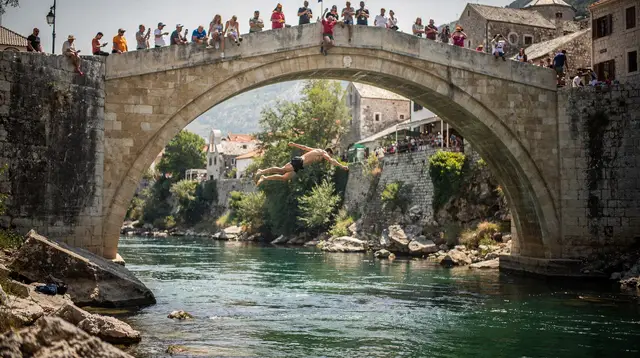
Start here, ideally from the east bank near the old bazaar entrance, so the bridge is your first landmark rather than your last. The single-arch stone bridge standing today was built in 1566 under Ottoman architect Mimar Hajrudin, destroyed by shelling on 9 November 1993, and rebuilt using the original construction techniques before reopening on 23 July 2004 - it has been inscribed as a UNESCO World Heritage Site, together with the historic core around it, since 2005.
Walk across it once slowly. The stone surface is smooth and sloped, worn by centuries of foot traffic, and can be genuinely slippery when wet - flat, grippy shoes matter more here than almost anywhere else in the old town. The bridge sits roughly 24 meters above the Neretva at summer water levels, though the exact height shifts with the river’s flow, so treat any number you see quoted as an approximate one rather than a fixed fact.
You may see members of the Mostari diving club - a tradition documented since 1664 - performing jumps from the bridge deck for tips collected from the crowd below. This happens more often when there is a paying audience gathered, which in practice means it is more likely during the same midday window that is otherwise worth avoiding for crowd reasons.
If watching a jump matters more to you than avoiding the crowds, that is a genuine trade-off worth deciding on purpose rather than by accident. Visitors who want to understand the jumping tradition itself, or who are considering doing a supervised jump themselves, will find both covered in more depth in our guides to watching the Stari Most divers and how the Stari Most jump actually works.
Stop 2: Kujundžiluk, the old bazaar
From the bridge, the lane leading east into the old town is Kujundžiluk - historically the coppersmiths’ quarter, and still the address for hand-hammered copper trays, coffee sets and pens sold from small workshop-fronts rather than generic souvenir stalls. The name itself comes from the Ottoman-era guild of coppersmiths who worked here, and a handful of workshops still hammer and engrave metal by hand rather than simply importing stock.
Fifteen to twenty minutes is enough to walk its length, browse a few stalls, and get a feel for the trade without committing your whole half day to it. If copperwork interests you specifically - what is hand-made versus imported, and what is worth buying versus skipping - our dedicated guide to Kujundžiluk’s copper craft goes into more detail than a half-day itinerary has room for. The same lane is also the easiest place to pick up a coffee or a quick bite before continuing to the mosque; cevapi and burek stalls line the route, though a proper sit-down meal is really a full-day-visit indulgence, not a half-day one.
Prices in the bazaar are generally quoted in Convertible Marks (KM), the local currency pegged at a fixed rate to the euro - 1 EUR equals 1.95583 KM, a rate set by currency board arrangement since 1997 and never adjusted since. Euros are often accepted at tourist-facing stalls, but change is typically handed back in KM, so budget for that when you are paying in cash. Our guide to money and paying in Convertible Marks covers this in more detail if you are arriving without local currency.
Stop 3: the Koski Mehmed-Paša Mosque and its minaret
The walk continues a short distance further to the Koski Mehmed-Paša Mosque, an Ottoman-era mosque whose courtyard and minaret are open to visitors for a modest entry fee - figure on the order of 6 to 15 KM (roughly 3 to 8 euros), with the minaret climb sometimes charged separately from the courtyard entry. Treat any specific number as an approximation and expect to pay in cash on site rather than by card.
The minaret climb itself is narrow - around ninety steps in a tight spiral staircase - and not for anyone uneasy with confined heights, but it delivers what is probably the single best available view of the Stari Most from above, framed against the Neretva and the old town roofline. If your half day has room for one optional extra fifteen minutes, this is where to spend it rather than adding a fourth destination elsewhere in the city.
Modest dress is expected inside the mosque itself - shoulders and knees covered - and shoes come off before entering the prayer hall, standard practice at any working mosque. If you would rather have a guide narrate the old town’s Ottoman-era buildings, including this mosque, as part of a structured walk instead of doing it solo, our guide to guided walks of Mostar’s old town lays out what that adds over a self-guided version.
If you unexpectedly have an extra hour
Half-day visitors sometimes find their schedule has more slack than planned - a delayed onward bus, a transfer that arrives early. If that happens and you are near the old town with an hour to spare, a short wine or rakija tasting is the easiest way to use it without derailing your return connection: a fifteen-to-twenty-minute walk from the bridge puts you within reach of tastings built around exactly this kind of short window, such as a quick Mostar wine tasting covering local Žilavka and Blatina pours, or a short rakija tasting session if fruit brandy interests you more than wine.
If your extra time is closer to half a day rather than one hour, and you would rather cover more ground than sit still, a rented bike from a Mostar bike hire extends the same old-town loop out toward the riverbanks at your own pace. And for a genuinely different half day built around a view rather than a walk, a via ferrata route up Hum hill trades the bazaar crowds for a vertical route and a panorama over the whole city - though that option needs closer to three or four hours on its own and does not combine easily with the walking route above on the same short visit.
None of these additions are required. The three-stop walk above stands on its own and is what most half-day visitors should actually plan for; treat the tastings, the bike and the via ferrata as options for the visitor whose schedule turns out looser than expected, not as a checklist to force into a tight window.
Practical notes before you go
A few small things make this walk noticeably smoother. Carry cash in KM for the mosque entry, the minaret, and any small bazaar purchases - card acceptance is inconsistent at small counters, and note that Kujundžiluk stalls that do accept euros will typically hand back change in KM rather than euros. Wear flat, closed shoes with real grip; the Stari Most’s polished stone surface and the bazaar’s uneven cobblestones both punish sandals and heels. Carry water regardless of season, since the old town offers very little shade and Mostar’s summer heat is genuinely severe by regional standards.
If you are arriving by private transfer or organized excursion rather than public transport, confirm your pickup point and return time before you start walking - the old town’s pedestrian lanes make it easy to lose track of exactly where a coach or driver is waiting. Visitors coordinating their own transfer from the coast rather than joining an organized excursion will find the logistics covered in our guide to private transfers from Dubrovnik and Split, and those still deciding between a fixed-departure excursion and independent travel should see our comparison of visiting Mostar as a day trip versus a longer stay.
Finally, keep this route separate in your head from any Mostar itinerary promising to cover more ground - the Bulevar’s war-era front line, Blagaj’s tekija, Počitelj’s citadel, or the panoramic view from Hum hill all belong to a longer visit, not a half-day one. Our full-day itinerary and our roundup of the best day trips from Mostar are the right starting points once you have more time to spend.
Half-day Mostar walk: frequently asked questions
Is half a day really enough to see Mostar?
Enough to see the essential three stops properly: the Stari Most, Kujundžiluk and the Koski Mehmed-Paša Mosque. You will not see Blagaj, Počitelj or the Bulevar’s war scars in that window - that needs a full day or an overnight stay.
What is the single best time of day to walk this route?
Before 10am or after 5pm in June-September. Midday in high season brings coach groups from Dubrovnik and Split straight to the bridge, and the narrow lanes of Kujundžiluk fill up fast between roughly 11am and 4pm.
Do I need tickets booked in advance for the mosque or the old town?
No advance booking is needed for a walk-in visit to the Koski Mehmed-Paša Mosque or the bazaar. Bring cash in Convertible Marks (KM) for the mosque entry and the minaret climb, since card payment is not reliable at small counters.
Can I do this half-day walk if I only have a few hours between a bus and a day trip?
Yes - this is exactly the itinerary it is built for. A visitor arriving by coach or transfer from the Adriatic coast, or catching a bus onward to Sarajevo, can fit the three core stops into three to four hours without rushing.
Will I see the bridge divers on a short visit?
Only if your timing lines up. The Mostari club’s divers perform when enough tips have been collected from the crowd on the bridge, which happens more reliably in the middle of the day in high season - the same window this route recommends avoiding for the crowds themselves, so there is a real trade-off.
Is the Koski Mehmed-Paša Mosque minaret worth the climb in a short visit?
Yes, if your half day allows fifteen extra minutes. It is the best available view of the Stari Most itself, reached by a narrow staircase of roughly ninety steps, and it is usually the fastest viewpoint to reach from the old town center.
What should I wear for this walk in summer?
Comfortable flat shoes for uneven cobblestones, and a top that covers the shoulders for the mosque visit. Mostar is the hottest city in Bosnia and Herzegovina in July-August, with little shade in the old town, so carry water.
City sightseeing tours on GetYourGuide
Verified deep-linked GetYourGuide tours. Book through these links and we earn a small commission at no cost to you.
GetYourGuide does not provide a product photo for this activity — the image shows the meeting point, photographed by us.