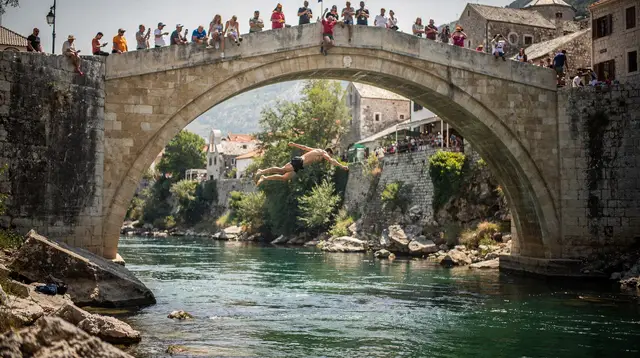
Mostar Off the Beaten Path
What is there to see in Mostar beyond the Old Bridge and the old bazaar?
Streets north and west of the Bulevar hold Austro-Hungarian apartment blocks, quiet residential courtyards, local cafés with no tourist menus, and memorials that trace the 1992-1995 front line more plainly than the rebuilt old town does. Most of it is walkable in two or three unhurried hours.
Most visitors to Mostar see the same half-mile: the Stari Most, the cobbled run of Kujundžiluk, a mosque courtyard, maybe a coffee with a bridge view. It’s a good half-mile, and there’s no reason to skip it. But it’s also a small fraction of the city, and once you’ve done it, the streets just beyond it are where Mostar stops performing for cameras and starts looking like a place people actually live.
This guide is for the second visit, or the second half of the first one: for travelers who’ve already covered the old town in a morning or a full day’s itinerary and have an afternoon left to spend without a checklist. It isn’t a hidden paradise story. Some of what’s here is quietly beautiful; some of it is a shelled apartment block that was never fully repaired. Both are part of the same city.
Why look beyond the Stari Most
The old town around Mostar’s bridge was largely rebuilt after the 1990s war and restored again for UNESCO status in 2005, which means it reads, deliberately, as a period piece: stone lanes, copper stalls, a single dramatic view repeated on every postcard. It’s authentic in its craftsmanship but curated in its presentation. A few streets away, nothing has been curated. Apartment blocks from the Austro-Hungarian era sit next to buildings still pocked with shrapnel scars, laundry lines cross balconies, and the cafés serve regulars rather than groups off a coach.
Seeing both sides isn’t about picking the “real” Mostar over the “fake” one, the old town is real too, just restored and commercially active. It’s about understanding that a city built on a fault line, geographic, imperial, and then military, doesn’t resolve itself into one clean picture. The quieter streets are where that layering is easiest to read on foot, without a plaque explaining it to you.
The Bulevar: the line that actually divided the city
A common assumption among first-time visitors is that the Neretva river split Mostar into two sides during the 1992-1995 war. It didn’t. The Bulevar, a broad avenue running roughly east-west through the city, was the actual front line, and its buildings still show it more plainly than almost anywhere else in town. Walk it slowly rather than crossing it in a taxi: facades pitted with old bullet and shell damage stand beside fully rebuilt shopfronts and, increasingly, new construction, sometimes on the same block.
This isn’t a street that asks to be treated as a memorial circuit, people commute along it, buses run down it, there are bakeries and pharmacies doing normal Tuesday business. But it’s worth knowing what you’re looking at. Mostar’s administrative and school systems have, for a long stretch since the war, remained organized largely along the same lines the Bulevar once marked, a detail that rarely makes it into a bridge photo but that shapes daily life in the city more than any single building does.
If you want the fuller picture before or after this walk, a dedicated guide to the war’s visible traces and one on understanding the 1992-1995 war cover the history in more depth than a walking route can.
Residential streets: Austro-Hungarian Mostar
Bosnia and Herzegovina was administered by Austria-Hungary from 1878 until the empire’s collapse in 1918, and that four-decade stretch left a visible mark on Mostar that has nothing to do with the Ottoman old town. West and north of the historic core, the street grid straightens out, buildings gain wrought-iron balconies and taller windows, and the general feel shifts from Ottoman market town to provincial Central European city, closer in spirit to a smaller Sarajevo street than to anything near the Stari Most.
These blocks are mostly residential, which is the point: nobody is selling anything to you here beyond the odd bakery or hardware store. A slow loop through them, courtyards glimpsed through open gates, older apartment buildings with their original stonework, the occasional Yugoslav-era block dropped in among them, gives a much better sense of how Mostar actually functions day to day than the old town does. It’s an easy contrast to notice once you know to look for it: pointed Ottoman-era rooflines and minarets to the east, flatter Central European facades a few minutes’ walk to the west.
For orientation on how the city’s districts relate to each other and where you might choose to base yourself for a longer stay, a neighborhood-by-neighborhood guide to where to stay covers this ground from a different angle, and a walking-and-local-bus primer on getting around Mostar on foot and by local bus is useful if you’d rather not retrace your steps back to the center.
Where locals actually sit
The cafés directly on the bridge approach and along Kujundžiluk are pleasant but built for turnover: quick coffee, a view, the next table waiting. A few streets back, in the residential blocks and along the quieter stretches near the Bulevar, the cafés look different, plastic chairs rather than curated seating, Bosnian coffee served in a cezve with a lump of sugar and a small glass of water, football on a television nobody’s really watching, and conversation in Bosnian rather than a script of tourist-facing English.
Nobody expects a visitor to blend in, and nobody minds one sitting down either. Order simply, a Bosnian coffee or a fruit juice, and don’t expect a menu translated into six languages. It’s a small, low-effort way to see a slice of daily life that the old town, by its nature, can’t offer. If food rather than coffee is the draw, a neighborhood guide to where to eat in Mostar points toward a few of these less-touristed spots specifically.
Memorials worth the detour
Two sites away from the bridge reward a deliberate visit rather than a passing glance. The Partisan Cemetery, designed by architect Bogdan Bogdanović and inaugurated in 1965 as a memorial to Yugoslav partisans of the Second World War, is a striking piece of modernist landscape design, terraced stone, abstract carved motifs, laid into a hillside above the city. It was damaged during the 1990s siege and left neglected for years afterward, but restoration work beginning in 2005, funded in part by Dutch and Norwegian contributions alongside local co-financing, has kept it maintained and accessible since; it is not a ruin today, and shouldn’t be described as one.
The second is less a single site than a general habit: walking the Bulevar itself, as covered above, functions as its own informal memorial route, no ticket, no opening hours, just an avenue that still carries the shape of what happened there. Between the two, you get a more complete picture of how Mostar remembers its recent history than any single museum stop provides, though the city’s dedicated war and photography exhibitions are worth adding if you want more structured context indoors.
A slow afternoon, mapped out
None of this needs a guide, a ticket, or much planning. A simple route: start at the southern end of the Bulevar, walk its length northward, noting the mix of restored and still-scarred buildings, then cut west into the residential grid for twenty minutes of unhurried wandering with no fixed destination, before finishing at a local café rather than one facing the bridge. Add the Partisan Cemetery at either end if you have an extra half hour and don’t mind a short uphill walk.
| Stop | What you’ll see | Time to allow |
|---|---|---|
| Bulevar (full length) | War-scarred and rebuilt facades side by side | 30-40 minutes |
| Residential streets west of center | Austro-Hungarian apartment blocks, quiet courtyards | 30-45 minutes |
| Local café off the tourist strip | Everyday Bosnian coffee culture | 20-30 minutes |
| Partisan Cemetery | Bogdanović’s 1965 modernist memorial | 30-40 minutes |
None of these stops carry an entry fee, and nothing here requires advance booking. If you’d rather cover more ground with less walking, renting a bike is a straightforward way to link the Bulevar, the residential quarters, and the riverbank in a single loop, a bike rental in Mostar covers a half-day or full-day hire with no fixed route required.
Pairing this with the rest of Herzegovina
A quiet afternoon in Mostar’s back streets works well as a counterpoint to a more active day elsewhere in the region. Travelers building out a longer stay often follow it with something physical the next day, a via ferrata route up Hum hill above the city gives a completely different view of the same Bulevar corridor from height, tracing the line you walked at street level the day before.
Others prefer to close the day with something slower rather than more active. A local heritage tasting of olive oil and small Herzegovinian bites or a guided rakija tasting both sit well after an afternoon spent on foot, and neither requires the crowds of the old town to enjoy. If wine suits the mood better, a short Žilavka and Blatina tasting in Mostar covers the region’s two signature grapes without a trip out to the vineyards themselves.
Photography beyond the bridge shot
If you’re carrying a camera, the contrast between the old town and these quieter streets is itself a subject: pointed Ottoman rooflines giving way to flat Austro-Hungarian facades within a five-minute walk, or a rebuilt shopfront standing directly beside one still marked by the 1990s. It’s a less obvious photograph than the Stari Most at sunset, but for anyone trying to say something true about the city rather than something pretty, it’s often the more useful one.
A dedicated guide to photographing Mostar’s old town covers the classic shots if you want both; the best viewpoints over Mostar guide adds a few elevated spots, including Hum hill, that take in the whole picture at once, bridge, Bulevar, and residential grid together.
What this walk is not
It’s worth being direct about the limits here. This isn’t a curated “secret Mostar” with hidden restaurants and undiscovered viewpoints, most of what’s described above is simply the ordinary, functioning city that surrounds the tourist core, and its main appeal is contrast rather than novelty. It also isn’t a substitute for the Stari Most and Kujundžiluk, which remain genuinely worth seeing first; this is what to add once you have. And it isn’t a neutral, history-free stroll either: the Bulevar in particular carries real weight, and treating it as just another pretty street misses what makes it worth walking in the first place.
If your schedule only allows a single extra hour beyond the standard sights, the Bulevar walk alone, done slowly, delivers most of what this side of Mostar has to offer. With a half day or more, adding the residential streets, a local café, and the Partisan Cemetery rounds it out into a fuller, quieter picture of a city that is a good deal more than one bridge.
FAQ: exploring Mostar beyond the Old Bridge
Is Mostar’s off-the-beaten-path side safe to walk on foot?
Yes, within the city itself. Streets, pavements, and marked routes around the Bulevar and the residential districts are safe and used daily by residents. The landmine caution that applies to rural Herzegovina concerns unmarked countryside, forest, and mountain terrain, not the paved city.
How much time should I set aside for this side of Mostar?
Two to three hours on foot covers the Bulevar corridor, one or two residential streets, and a café stop. It pairs naturally with a half-day or full-day visit that already includes the Stari Most and Kujundžiluk.
Is the Bulevar still a visible dividing line in the city?
Physically, yes: shelled and rebuilt buildings sit side by side along it, and the avenue still marks how the city’s school and administrative networks are organized. It is not a re-enactment for visitors, just an ordinary street that carries a specific history.
Are there guided tours that cover this side of Mostar?
Most standard walking tours focus on the old town and the bridge. A private guide can be asked in advance to extend a route across the Bulevar and into a residential quarter; otherwise this is straightforward to do independently with a map.
What is the Austro-Hungarian architecture in Mostar, and where is it?
Austria-Hungary administered Bosnia and Herzegovina from 1878 to 1918 and left apartment blocks, civic buildings, and a European street grid west and north of the Ottoman old town, a visible contrast to the Ottoman-era core around the Stari Most.
Should I avoid presenting these neighborhoods as purely peaceful or “moved on”?
Yes. The quieter streets are genuinely pleasant to walk, but the war’s imprint, damaged facades, a still-divided school system, memorials, is part of what is there. Neither ignoring it nor centering every street on it reflects the place accurately.
City sightseeing tours on GetYourGuide
Verified deep-linked GetYourGuide tours. Book through these links and we earn a small commission at no cost to you.
GetYourGuide does not provide a product photo for this activity — the image shows the meeting point, photographed by us.