Cycling Mostar and the Neretva Valley
Is cycling a good way to see Mostar and the Neretva Valley?
Yes for the flat river sections and quiet valley roads, but the karst terrain around Mostar is hilly, exposed, and often very hot from June to September. A standard bike works well in spring and autumn; an e-bike makes summer riding realistic rather than exhausting.
Why cycling here feels different from a flat river town
Mostar sits in a river valley, and rivers suggest flat, easy riding. The Neretva itself mostly delivers on that — the valley floor toward Blagaj and the Buna spring is gentle, shaded in patches, and genuinely pleasant on two wheels. What catches first-time visitors off guard is everything around that flat core: Mostar is ringed by karst hills, the same bare limestone terrain that defines all of Herzegovina, and almost any route that leaves the valley floor starts climbing, often on exposed asphalt with no tree cover at all.
That combination — a genuinely flat, rideable core and a genuinely hilly, exposed periphery — is the single fact that should shape how you plan a cycling day here. It also explains why this guide keeps circling back to one recommendation: consider an electric bike, especially between June and September, rather than assuming a standard bike will do because the map looks flat.
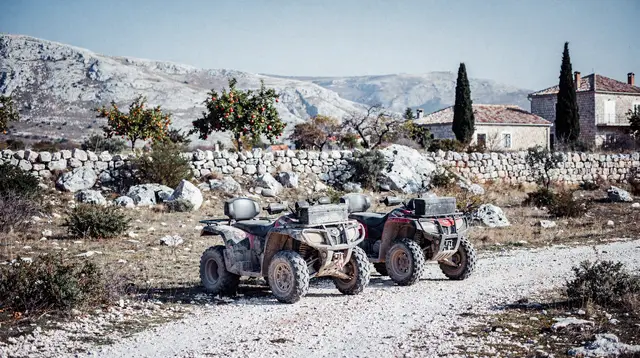
This page is about cycling as a way to move through Mostar and the Neretva Valley at your own pace — not the specific fixed corridor of the old narrow-gauge line, which has its own dedicated route guide, and not motorized options like quad or buggy, which are covered separately and solve a different problem (covering rough ground fast, with an engine doing the work).
The heat problem, stated plainly
Mostar is the hottest city in Bosnia and Herzegovina, with July and August afternoon highs typically in the upper twenties Celsius and spikes well past 40 degrees during heat waves. That heat is dry, which makes it feel deceptively manageable at first — until an hour into a climb with no shade, when it isn’t.
A standard bicycle on a cool spring morning is a completely different proposition from a standard bicycle at 2pm in August on a karst hillside road. The terrain doesn’t change between seasons, but your margin for error does. This is the piece that’s easy to romanticize away: a normal bike is not automatically “enough” just because the valley floor looks flat on a map. The hills exist, the heat exists, and the two together are exactly where an e-bike earns its rental fee.
If you’re planning a cycling day for July or August specifically, read the month-by-month guide to when to visit alongside this one — it will tell you whether you’re looking at a manageable morning or a genuinely risky midday window.
Standard bike or e-bike: an honest comparison
| Standard bicycle | Electric bike | |
|---|---|---|
| Valley floor (Mostar–Blagaj, flat riverside roads) | Comfortable, no real downside | Comfortable, arguably overkill |
| Karst hill climbs (viewpoints, village connectors) | Hard work, worse in heat | Manageable, assist handles the grade |
| April–May, September–October | Good choice | Nice to have, not essential |
| June–August afternoons | Risky without a lot of water and a slow pace | The realistic option for most riders |
| Multi-day valley touring (Mostar toward Konjic) | Demanding, more traffic exposure | Preferred by most operators renting for this |
| Rental cost | Lower | Higher, but usually worth it in summer |
None of this means a standard bike is a bad choice — it’s a fine one outside the hottest months, and plenty of confident cyclists ride it in summer too, just with an early start, a heavy water supply, and a route that avoids the worst midday climbs. What this table is meant to prevent is the opposite mistake: assuming a rented city bike will handle a hilly August afternoon the same way it handles a flat morning ride, and finding out otherwise halfway up a shadeless slope.
Renting a bike in Mostar
Small rental operations cluster near the old town and along the Bulevar, the avenue that also marks the old wartime front line and now doubles as one of the more practical, shaded-in-places routes out of the historic center. Rentals are typically priced by the half-day, full day, or multi-day block, with both standard and electric models on offer, though the electric fleet is smaller and sells out first in peak summer.
renting a bike locally in Mostar is the simplest way to get moving without committing to a fixed group itinerary — you choose the route, the pace, and whether today is a standard-bike day or an e-bike day. It pairs naturally with the guide to getting around Mostar on foot and by local bus, since most visitors mix walking, a local bus, and a rented bike depending on the day.
If self-guided planning isn’t what you’re after, a structured alternative exists: a guided cycling tour through the city’s highlights covers the old town and river approaches with a local guide setting the pace and route, useful if you’d rather not work out the hills yourself on a first visit.
Realistic rides from Mostar
Mostar to Blagaj (roughly 12 km one way). Mostly flat valley road following the general line of the Neretva and Buna rivers, with the Blagaj tekija and its dramatic spring-fed cliff as the payoff. This is the single best beginner-friendly ride in the area and works well on a standard bike outside the hottest weeks. Combine it with the wider Blagaj destination guide for what to do once you arrive.
Along the Bulevar and into the old town. A shorter, more urban ride that lets you see the front line avenue, the approach to Stari Most, and the old bazaar district without tackling any real climbing. Good for an easy first evening or a wind-down ride after a harder day.
Toward Konjic and Jablanica. This is where distance and elevation both step up — more traffic on the main road, real climbing in places, and a longer day overall. Most riders who attempt this stretch do it on an e-bike, or split it with a train or bus leg, since the train between Mostar and Sarajevo and regional buses run this same corridor and can carry you (and often your bike) past the hardest sections. If cycling the full Neretva Valley end to end interests you, the Neretva nature itinerary frames a multi-day version of this journey that isn’t all on a bike saddle.
For riders specifically wanting a longer, more athletic day on two wheels with support built in, a road bike day trip through Bosnia and Herzegovina covers more distance than most self-guided rentals comfortably would, with logistics handled for you.
What cycling does not cover well here
Two things this guide deliberately steers away from. First, the dedicated former railway corridor repurposed for cycling and walking has its own fixed route, gradients, and tunnels, and deserves its own planning — see the separate guide to that trail rather than treating it as an extension of general valley riding. Second, if what you actually want is to cover rough, unpaved ground quickly without pedaling — old logging tracks, quarry roads, off-highway terrain — that’s a motor-driven answer, and quad and buggy touring is the right guide, not this one.
It’s also worth being honest that cycling isn’t the only way to reach the valley’s highlights, and on a very hot day it may not be the best one. A day trip that covers Mostar and Kravice by car or minivan removes the heat exposure entirely, which is a reasonable trade if the forecast is against you: joining a day trip to Mostar and the Kravice waterfalls gets you to some of the same valley scenery without pedaling through the hottest hours.
Safety notes specific to cycling here
The roads and marked paths around Mostar, Blagaj, and the valley are safe to ride — the landmine risk that remains in parts of rural Bosnia and Herzegovina concerns unmarked land away from roads and trails, roughly 1.6% of the country’s territory, mostly in remote forest and hillside terrain. It has no bearing on sealed roads or established routes. The one rule worth internalizing: never leave a marked road or path to cut across an open field or wooded slope, however tempting a shortcut looks on a hot climb.
Heat and hydration matter more than traffic on most of these routes. Carry more water than feels necessary — the dry karst air masks how much you’re losing — and treat tap water in Mostar as a reliable refill source rather than relying only on bottled water bought along the way. Start climbs early in the morning or leave them for the last light of the day rather than riding them at midday in July or August.
If you’re combining a cycling day with hiking later in the trip, the general hiking checklist for Herzegovina doubles well as a cycling-day packing reference, and routes further into the hills — Blidinje and Mount Prenj or the canyon trails near Jablanica — are worth reading before you plan a route that strays from the valley floor toward higher ground.
Planning the logistics around a cycling day
Bikes fit awkwardly with some transport options and easily with others. If you’re driving in from Dubrovnik or Split and plan to rent a bike once in Mostar, the guide to renting a car and crossing the border covers the logistics of getting yourself there; once you’re in town, parking in Mostar and picking up a rental bike work well together, since most cycling routes start from roughly the same central area near the old town and the Bulevar.
For a wider view of how a cycling day fits into a longer stay, the question of how many days to spend in Mostar is worth reading — a half-day bike ride to Blagaj slots easily into a two-day visit, while a longer valley ride toward Konjic or Jablanica is more realistic if you have three days or more and aren’t trying to also fit in Kravice, Medjugorje, and the old town on foot the same trip.
The short version
Cycling is one of the better ways to see the Neretva Valley at a human pace — quiet roads, river views, and villages you’d otherwise drive past. The valley floor toward Blagaj rewards a standard bike almost any time of year. The hills around Mostar, and any route attempted in the peak of a July or August afternoon, reward an e-bike, not out of luxury but out of plain thermal math: the same climb that’s pleasant in May can be genuinely draining in August, and an electric assist is what keeps the ride enjoyable rather than something to survive.
Frequently asked questions about cycling in Mostar and the Neretva Valley
Do I need an electric bike in Mostar, or is a normal bike enough?
A normal bike is fine in April, May, September, and October. In July and August, when afternoon temperatures regularly pass 35 degrees and sometimes exceed 40, an e-bike turns a punishing climb into a manageable ride and lets you actually enjoy the valley instead of surviving it.
Where can I rent a bike in Mostar?
Small rental shops near the old town and along the Bulevar offer both standard and electric bikes by the half-day, full day, or multi-day. Booking a rental ahead in July and August is worth it, since the better e-bikes sell out early in high season.
Is the terrain around Mostar flat or hilly?
It is genuinely mixed. The riverside paths near the Neretva and the valley floor toward Blagaj and Buna are gentle, but roads climbing toward viewpoints or connecting villages in the karst hills gain real elevation quickly, often on exposed, shade-free asphalt.
Can I cycle from Mostar to Blagaj or Konjic?
Blagaj is a realistic half-day ride on mostly flat valley roads, well suited to a standard bike outside summer. Konjic is farther and involves more climbing and traffic on the main road, which is where most riders switch to an e-bike or combine cycling with a train or bus leg.
Is there a dedicated cycling route through the Neretva Valley?
The best-known dedicated route is the former narrow-gauge railway corridor repurposed for cycling and walking, covered separately in its own guide, since it follows a fixed line rather than the free-roaming valley riding this page focuses on.
Are the roads safe for cycling, and what about landmines?
Sealed roads and marked paths around Mostar, Blagaj, and the valley are safe for riding. The landmine risk in Bosnia and Herzegovina concerns unmarked rural land away from roads and trails, not the asphalt or established cycling routes covered here — never leave a marked road or path to cut across a field or wooded slope.
What should I carry on a summer cycling day in Herzegovina?
More water than feels necessary, sun protection, a phone with an offline map, and a plan to ride the exposed climbs early or late rather than at midday. Shade is scarce on the karst hillsides, and the dry heat dehydrates faster than it feels like it should.
Cycling and e-bike tours on GetYourGuide
Verified deep-linked GetYourGuide tours. Book through these links and we earn a small commission at no cost to you.
GetYourGuide does not provide a product photo for this activity — the image shows the meeting point, photographed by us.