Ćevapi Diplomacy: What Mostar's Food Actually Says
The first time someone told me that Mostar’s food was proof the city had moved on, we were standing at a grill counter with smoke in our eyes, and I almost believed it. Ten ćevapi came up on a metal tray, packed into a round of warm somun, a spoon of kajmak melting on top. The man behind the counter didn’t ask where I was staying or which side of town I’d come from. He just asked if I wanted onion. That’s the whole transaction, and it happens the same way at counters all over Mostar, on both banks of the Neretva and on both sides of the Bulevar.
It’s a nice story. It’s also not the whole story, and I want to be careful here, because it would be easy to write this piece as “look how food heals all wounds” and call it a day. It doesn’t. What ćevapi and burek actually tell you about Mostar is narrower and more interesting than that.
A grill that doesn’t check your address
Ćevapi is Ottoman in origin, and in Mostar nobody treats it as a symbol of anything in particular — it’s just what you eat when you’re hungry and it’s lunchtime. Small rolls of minced meat, grilled fast over charcoal, stuffed into somun with raw onion and a spoon of kajmak if the place makes its own. Burek, the other half of the everyday diet here, is a different animal entirely: filo pastry rolled tight and baked, usually with minced meat inside, sold by weight or by the slice from places that open before most people are awake and sell out by mid-afternoon.
I ate both, repeatedly, in the old town near Kujundžiluk and again in newer streets further from the river, and the honest observation is that the food doesn’t change character depending on which side of the avenue you’re standing on. The same technique, the same bread, and the same coffee ritual afterward in a copper cezve. If you wanted a single piece of evidence that the two halves of Mostar share more daily life than the news coverage from the 1990s would suggest, this is a reasonable one to pick.
But notice what that evidence actually proves: that a grill and a good burek recipe don’t care about municipal boundaries. It doesn’t prove that the boundaries themselves have gone away. Mostar still runs, in real and documented ways, with separated school systems and civic institutions that trace their split to the war — a structural fact that has nothing to do with what’s for lunch. I’m not going to relitigate that division here; The Avenue That Still Divides Mostar does that properly, and it’s worth reading if you want the actual mechanics of the Bulevar as a former front line.
What a shared table can and can’t do
Here’s the honest limit of the food angle, and I think it’s worth saying plainly rather than dressing it up. A ćevapi counter is a place where people from different communities happen to stand next to each other, order the same thing, and leave without incident. That is genuinely pleasant to witness and worth noticing as a visitor. It is not reconciliation. Reconciliation is a political and institutional process, and it has its own timeline that a grilled meat roll cannot accelerate.
What food can do, more modestly, is give you a way into a complicated city that doesn’t require you to have an opinion about a war you didn’t live through. You can sit down, order, and just be a person eating lunch in Mostar — and from that unremarkable position, you start noticing things. You notice that the old Ottoman house museums and the food both come from the same centuries of Ottoman presence in Herzegovina, which is a longer and calmer story than the 1990s.
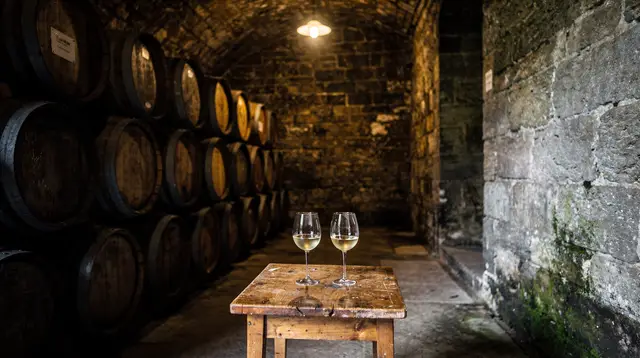
You notice how much of the local wine — Žilavka and Blatina, from vineyards not far from Čitluk — gets poured at the same restaurants that serve ćevapi, without anyone treating that pairing as a statement, and how easily a meal turns into a stop on the Herzegovina wine route.
If you want the fuller argument about how to visit a still-divided city without turning the whole trip into either denial or voyeurism, that ground is covered in Visiting a Still-Divided City, and I’d read it alongside this piece rather than instead of it. This one is only about the table.
Doing it properly, if you’re here for a day or two
Practically, a ćevapi meal in Mostar costs very little and takes maybe thirty minutes, so there’s no reason to have just one during a visit. My advice, for what it’s worth: eat your first ćevapi somewhere central and unpretentious rather than at the most photographed restaurant nearest the bridge, because the good ones tend to be a few streets back, judged by how many locals are also eating there at 1pm on a Tuesday.
Follow it with a Bosnian coffee, not an espresso — it’s a different ritual, slower, and it’s rude to rush it. If you’re still hunting for that first counter, Where to Eat in Mostar is a better starting list than whatever’s closest to the bridge, and a small glass of rakija afterward is entirely normal, even at lunch.
If you want to go beyond a single meal, Herzegovina’s food culture opens up quickly once you’re outside the old town. There’s an olive grove tasting a short drive from the city — the Mostar olive grove tour and oil tasting at Paša Dola puts the region’s Ottoman-era agricultural history on your plate rather than just on a placard.
For a longer day that folds in the wider region’s wine and countryside alongside the historic sites, the full-day Mostar and Herzegovina tour is a reasonable way to see how the food connects to the landscape around it. And if you’re coming from the coast for a single day and want a private pace rather than a bus schedule, the private Mostar and Kravice waterfalls day trip leaves enough slack in the itinerary to actually sit down for lunch instead of eating standing up between stops.
None of this is a substitute for reading about the war, or about the Bulevar, or about what a divided municipal administration actually means day to day — that history matters and food doesn’t paraphrase it. But if you’re looking for a concrete, unpretentious way into a city that resists easy summary, start at a grill counter. Order ten pieces, ask for extra onion, and just watch who else walks in.
FAQ: Food, Ćevapi, and What They Do (and Don’t) Explain About Mostar
Is ćevapi originally Bosnian or Serbian?
Ćevapi has Ottoman roots and is claimed, cooked, and argued over across the whole former Yugoslav region, including Serbia, Bosnia and Herzegovina, and Croatia. In Mostar it is treated as local food, full stop, without much interest in settling the wider regional debate.
What is the actual difference between ćevapi and burek?
Ćevapi are small grilled minced-meat rolls, usually served in warm somun bread with raw onion. Burek is a baked filo pastry, most often filled with minced meat, though cheese and potato versions exist under other names in the same pastry family.
Do people from different communities in Mostar actually eat at the same restaurants?
Yes, at the well-known ćevapi and burek places, especially near the old town and along the main streets on both sides of the Bulevar. It is ordinary, unremarkable, and has been true for years — it just is not the same thing as the city’s administration being unified.
Is a food tour in Mostar a good way to understand the city’s history?
It is a good starting point for texture and everyday life, but it is not a substitute for the history itself. Pair a meal with a guide who will talk plainly about the 1992-1995 war and the Bulevar if you want the fuller picture.
What should I order on a first ćevapi meal in Mostar?
A standard portion of ten pieces in somun, with kajmak and raw onion on the side, plus a small Bosnian coffee afterward. Most places also serve grilled peppers and a simple salad if you want something lighter alongside it.
Can I do a proper food or wine tasting near Mostar, not just a meal?
Yes. Herzegovina’s Ottoman-influenced food culture pairs naturally with the region’s Žilavka and Blatina wines and its olive groves, and both are covered on organized full-day tours out of the city.
Food and drink tours on GetYourGuide
Verified deep-linked GetYourGuide tours. Book through these links and we earn a small commission at no cost to you.
GetYourGuide does not provide a product photo for this activity — the image shows the meeting point, photographed by us.