Sevdalinka: Mostar's Traditional Melancholy Music
What is sevdalinka and where can I hear it in Mostar?
Sevdalinka is a centuries-old Bosnian urban love-song tradition rooted in Ottoman-era Herzegovina, built on themes of longing and melancholy rather than background music. In Mostar it is performed live after dinner in a handful of old town restaurants, usually by a small ensemble of accordion, guitar or saz-descended strings, and voice.
A song tradition, not a soundtrack
Spend one evening in Mostar’s old town and you will likely hear a voice rise over an accordion somewhere near the Stari Most: slow, ornamented, unmistakably mournful even if you don’t understand a word of Bosnian. That is sevdalinka, and it is worth knowing what you are actually listening to before you sit down to it. Too many visitors file the sound away as “folk music playing in the background of dinner,” the same mental drawer as a lute player in a Tuscan trattoria. Sevdalinka deserves better than that drawer. It is a named, historically documented urban song genre with its own repertoire, its own vocal technique, and a four-century relationship with the region you are standing in.
This guide focuses squarely on that music: what sevdalinka is, where it comes from, how it is performed, and how to hear it properly during a stay in Mostar. It does not cover what you eat while you listen to it, which has its own guide to Bosnian cuisine, nor the murals and graffiti that give Mostar’s post-war walls their second, very different visual voice, which also has its own guide. Think of this page as the companion for anyone who wants their evening in the old town to be a cultural encounter, not just a meal with music in the room.
What the word sevdalinka actually means
Sevdalinka takes its name from sevda, a word Bosnian absorbed from Ottoman Turkish, which in turn borrowed it from the Arabic sawda, meaning black bile. In the old humoral medicine that both Ottoman and earlier Greek physicians worked from, black bile was the humor associated with melancholy. Sevda came to mean something closer to lovesickness, an ardent, often unresolved longing rather than a strictly negative feeling. A sevdalinka, then, is literally a song of that particular ache: love that is intense, usually thwarted or separated by distance, class, family, or war, and expressed with a controlled sadness rather than despair.
That etymology matters because it explains the tone visitors sometimes mistake for simple sadness or exoticism. The songs are not laments in the sense of funeral music, and they are not romantic ballads in the Western pop sense either. They occupy a narrower emotional register: yearning that is savored, almost performed as its own pleasure, sung slowly enough that every held note and vocal slide can be felt. Bosnian audiences take this seriously. A good sevdalinka singer is judged on control of that ornamentation, not on volume or crowd-pleasing energy, which is part of why the genre survives so awkwardly when it is treated purely as ambience.
Ottoman roots, urban life, and four centuries of borrowing
Sevdalinka is usually dated to the Ottoman period in Bosnia and Herzegovina, broadly from the arrival of Ottoman rule in the fifteenth century through to the Austro-Hungarian takeover in 1878, with the genre’s core repertoire largely crystallizing across the sixteenth to nineteenth centuries. It is, specifically, an urban genre.
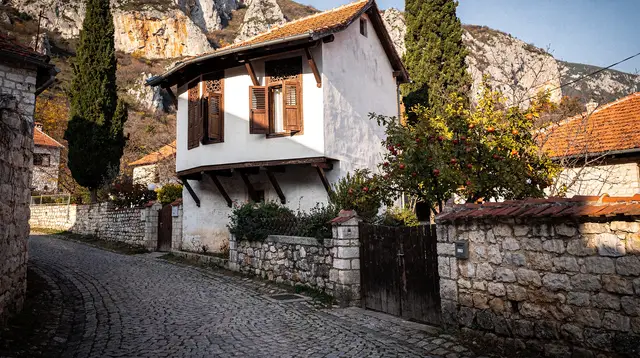
Where much Balkan folk music grew out of rural agricultural or shepherding life, sevdalinka took shape in Ottoman towns like Mostar, Sarajevo, and Travnik, among a merchant and craft class living close to mosques, bazaars, and the Ottoman-era houses whose enclosed courtyards, it is worth noting, were themselves partly designed around the same domestic, semi-private social life the songs describe.
The musical material that fed into sevdalinka is genuinely mixed. Ottoman classical and Sufi music supplied melodic modes and the practice of extended vocal ornamentation. South Slavic oral song traditions, already present in Bosnia before Ottoman rule, supplied narrative structure and language.
Sephardic Jewish communities, who settled in Bosnian towns including Sarajevo after expulsion from Spain in 1492 and built communities that lasted until the Second World War, are widely credited by musicologists with contributing melodic lines and vocal techniques of their own, particularly audible in some of the older, more melismatic songs. The result is not a pure Ottoman import transplanted onto Bosnian soil, but a genuinely regional synthesis, which is exactly why it does not sound quite like Turkish classical music, quite like Sephardic romances, or quite like Serbian or Croatian rural song, despite drawing on all three.
If you want the broader architectural and cultural context this music grew up alongside, rather than the music itself, the dedicated read on Ottoman heritage across Herzegovina covers the mosques, houses, and civic buildings from the same centuries.
The sound: voice, instruments, and what changed over time
For most of its history, sevdalinka was accompanied primarily by the saz, a long-necked, fretted lute of Ottoman Turkish origin with a thin, resonant tone well suited to close, intimate rooms rather than open-air performance. Solo or lightly accompanied voice over saz remained the core setup for centuries, and some traditionalist performers and folklore ensembles still use it today specifically to signal a return to the genre’s older sound.
Under Austro-Hungarian rule after 1878, and more sharply through the twentieth century, the instrumentation shifted. The accordion, guitar, and occasionally violin, clarinet, or double bass entered the ensemble, partly because they were more widely available and more adaptable to indoor restaurant or cafe performance, and partly because Yugoslav-era radio and recording culture, from the 1950s onward, standardized a fuller small-ensemble arrangement that most listeners today would recognize as “the” sevdalinka sound. This is the version you will almost always hear live in Mostar now: a singer, an accordion carrying the main harmonic and melodic support, and usually a guitar or second stringed instrument filling in.
What has not changed is the vocal approach. Sevdalinka singing rests on melisma, stretching a single syllable across several notes, and on a controlled vibrato and slide between notes that a singer uses deliberately, not as embellishment for its own sake but to carry the emotional weight of a particular line. Tempo stays slow to moderate throughout almost the entire genre; there is no fast, danceable branch of sevdalinka the way there is in some other Balkan folk traditions. That slowness is a feature, not a lack of energy: it is what gives a singer room to shape each phrase.
Where to actually hear it in Mostar
A handful of restaurants clustered in and around the old town, within easy walking distance of the Stari Most and the old bazaar, host live sevdalinka in the evening, generally as a set that begins once the main dinner service has wound down rather than as continuous background accompaniment. This detail matters for planning: turning up at seven expecting a full performance already underway is usually the wrong assumption. A later evening, once the day-trip crowds from Dubrovnik and Split have cleared out of the old town, is typically both quieter and closer to when a set actually starts.
Because which specific restaurants program live music, and on which nights, changes with the season and with individual venues’ own schedules, this guide deliberately does not lock in a fixed list of names likely to go stale. The reliable approach on the ground is to ask your accommodation for that week’s recommendation, or to walk the old town’s restaurant row in the early evening and look for a small stage area, an accordion case by the door, or a handwritten note about that night’s program. High season, June through September, is when live performances are most consistent; outside those months, expect fewer nights with music and more variation restaurant to restaurant.
| What to expect | Typical detail |
|---|---|
| When it starts | After the main dinner service, often from around 8 or 9pm |
| Setting | Small old-town restaurant, indoor or covered courtyard |
| Ensemble size | Usually a singer plus accordion, sometimes guitar or violin |
| Cover charge | Rarely separate; usually built into the evening at the restaurant |
| Best season for consistency | June to September |
| Booking | Recommended in high season given small room sizes |
For the practical question of eating well before or during that evening, the separate guide to where to eat in Mostar by neighborhood covers that ground; this page stays focused on the music itself.
Sevdalinka is not the only Bosnian sound you might hear
Visitors sometimes lump every acoustic performance they hear in the Balkans into one undifferentiated category, and it is worth drawing a couple of clear lines. Sevdalinka is not Balkan brass band music, the fast, punchy wind-instrument tradition most associated with Romani musicians and outdoor festival settings further north and east in the region; the tempo, instrumentation, and emotional register are almost opposites.
It is also distinct from ganga, an older rural polyphonic vocal style found in parts of Herzegovina and Dalmatia, sung by groups rather than a soloist, in tight dissonant harmony, without instrumental accompaniment at all. If a performance you encounter sounds harsh, close-harmonied, and instrument-free, you are more likely hearing ganga or something adjacent to it than sevdalinka.
Within Bosnia itself, you may also hear the word sevdah used almost interchangeably with sevdalinka in casual conversation. Sevdah more properly refers to the broader feeling or spirit the songs express, while sevdalinka is the specific song form; in practice, calling either the music or the mood “sevdah” will be understood, and no one will correct a visitor gently making that substitution.
The genre’s near-disappearance and its modern revival
Sevdalinka’s fortunes have not been steady across the twentieth century. Socialist-era Yugoslavia both preserved and reshaped the genre: state radio and folklore ensembles recorded and standardized many songs from the 1950s through the 1980s, which is how a large share of the repertoire performed today was fixed in its current arrangement, but the same institutional packaging sometimes flattened regional and individual variation in favor of a smoother, radio-friendly style.
The wars of the 1990s were harder on the tradition than any earlier period. Many performers, along with a large share of the urban populations that had sustained cafe and restaurant culture in cities like Mostar and Sarajevo, were displaced, killed, or scattered abroad, and the venues where sevdalinka had traditionally been performed were, in some cities, destroyed outright or emptied of their audience for years. That the genre survived at all owed a great deal to diaspora communities who kept performing and recording it abroad, and to a smaller number of musicians and researchers inside Bosnia who treated the repertoire as something to be actively preserved rather than assumed to continue on its own.
Since the 2000s, sevdalinka has seen a genuine, if modest, revival, including younger Bosnian musicians reworking the repertoire with jazz or classical arrangements for concert audiences well beyond the traditional restaurant setting, alongside older-style ensembles that keep performing the songs closer to their original form. In Mostar specifically, the tourism recovery that followed the reconstruction of the Stari Most and its 2004 reopening gave old-town restaurants a renewed commercial reason to keep live sevdalinka going, which is part of why the tradition is easier to encounter here today than it might otherwise be in a city of Mostar’s size.
Making the most of an evening built around the music
If you want the evening to actually register as a cultural experience rather than dinner with music playing somewhere in the room, a few habits help. Arrive with enough time that you are not still eating when the set starts, since a good singer deserves attention rather than being background to conversation.
Ask, if you can, whether the songs being performed that night include any of the better-known older sevdalinka standards; staff or the musicians themselves are often glad to explain a song’s story to an interested visitor, and that context changes how the melancholy in the melody lands. If the room allows it, sitting a little closer to the performers rather than at the back makes a real difference given how much of the genre’s effect depends on vocal nuance that does not carry well across a noisy room.
Pairing the evening with some daytime context helps too. Walking the old town earlier in the day with an eye for its Ottoman-era layout, ideally with the dedicated guided walk of Mostar’s old town or a stop inside one of the Ottoman house museums, gives the evening’s music a physical backdrop: the same enclosed courtyards, the same call to prayer from the Koski Mehmed-Pasa minaret, the same merchant-town rhythm that shaped the genre in the first place.
A number of visitors also like to close the day with the view from one of Mostar’s best viewpoints over the city before heading down into the old town for dinner and music, watching the light change over the Neretva as a kind of overture to the evening ahead.
For travelers weighing how much time this kind of evening deserves against everything else Mostar and Herzegovina offer, the practical planning questions, how many days to allocate, where to stay for easy access to the old town at night, and whether to build the whole trip around Mostar or treat it as a stop, are answered separately in the guides on how many days to spend in Mostar, which neighborhood to stay in, and choosing between a day trip and a longer stay.
Extending the evening beyond the restaurant table
A live sevdalinka set is not the only way to spend an evening or a spare afternoon engaging with Mostar’s artistic side rather than its monuments alone. If painting and craft interest you more than music, a boutique painting session inside a working artist’s studio offers a hands-on counterpart to a night of listening, and works well as a quieter afternoon activity before an evening of music.
Since the same restaurant culture that hosts sevdalinka in the old town is often built around a glass of local wine, a guided wine route through Herzegovina’s old-town vineyards or a shorter focused wine tasting in Mostar pairs naturally with a night out, letting you arrive at dinner already primed on the region’s Zilavka and Blatina before the music starts.
For a slower, more rural half-day that steps outside the old town entirely, a tasting session on an olive grove with oil tasting just outside Mostar makes a good daytime complement to an evening centered on song.
None of these substitutes for the music itself, and none of them require abandoning the old town for the day. Together, though, they round out what a stay built partly around Mostar’s living culture, rather than its historic sites alone, can look like: a walk through Ottoman-era streets by day, a tasting or a studio session in the afternoon, and a slow, deliberately melancholic set of sevdalinka after dinner, in a room small enough that every ornamented line the singer holds actually reaches you.
Art and culture tours on GetYourGuide
Verified deep-linked GetYourGuide tours. Book through these links and we earn a small commission at no cost to you.
GetYourGuide does not provide a product photo for this activity — the image shows the meeting point, photographed by us.